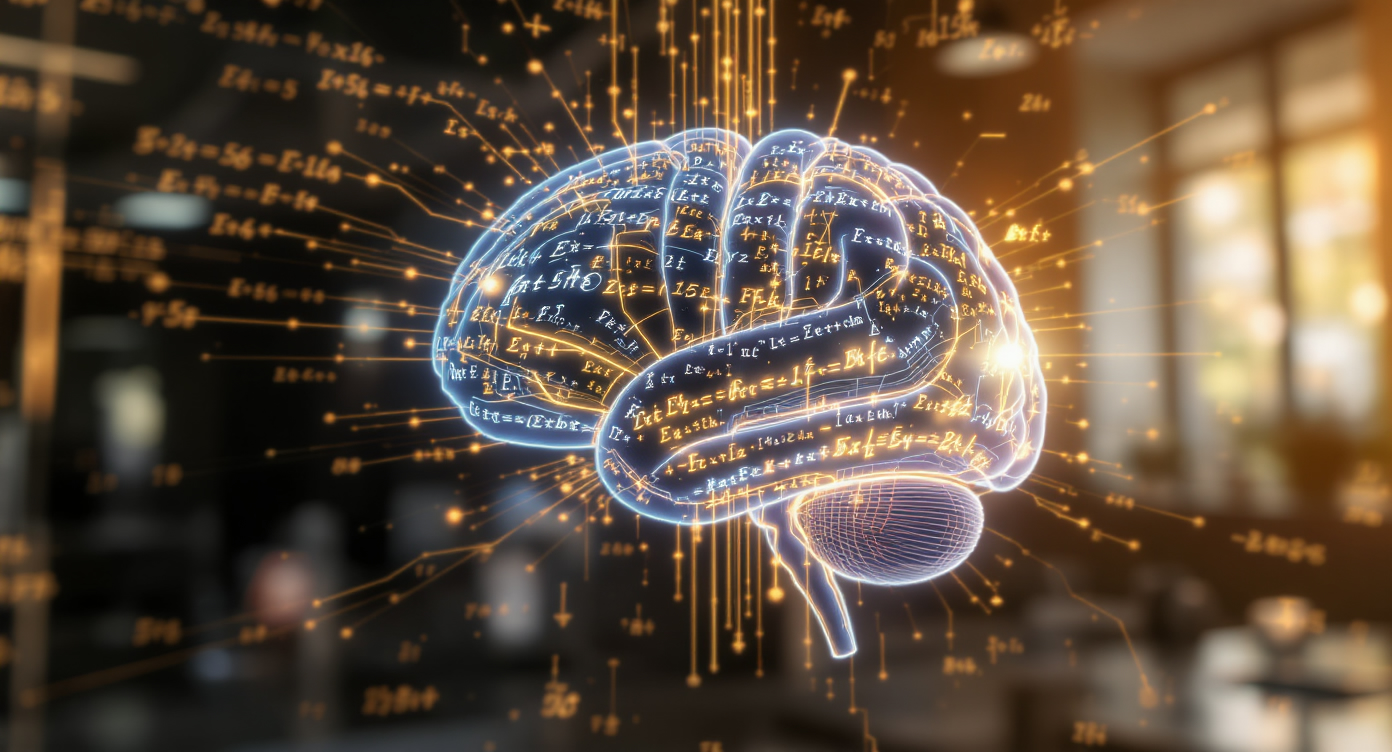
The artificial intelligence landscape has witnessed a monumental breakthrough with OpenAI’s latest iteration, GPT-5, demonstrating unprecedented mathematical reasoning capabilities that rival human-level performance. This achievement marks a pivotal moment in AI development, fundamentally changing how we perceive machine intelligence and its applications across various domains.
For years, mathematical reasoning has remained one of the most challenging frontiers for artificial intelligence systems. While previous models excelled at pattern recognition and language processing, they often struggled with complex mathematical problem-solving that required multi-step logical reasoning, abstract thinking, and the ability to work with novel mathematical concepts. GPT-5’s breakthrough in this area represents a quantum leap forward in AI capabilities.
The significance of this achievement extends far beyond academic circles. Mathematical reasoning forms the foundation of numerous critical fields, including engineering, finance, scientific research, and technology development. When an AI system can match human-level performance in mathematical thinking, it opens doors to revolutionary applications that were previously unimaginable.
What Makes GPT-5’s Mathematical Reasoning Revolutionary
GPT-5’s mathematical prowess stems from several key innovations that distinguish it from its predecessors. Unlike earlier models that primarily relied on pattern matching and memorization of mathematical formulas, GPT-5 demonstrates genuine understanding of mathematical principles and can apply them creatively to solve novel problems.
The model exhibits remarkable proficiency in abstract mathematical reasoning, successfully tackling complex problems in algebra, calculus, geometry, and even advanced topics like number theory and mathematical proofs. What sets GPT-5 apart is its ability to break down complex problems into manageable components, identify relevant mathematical principles, and construct logical solution pathways that mirror human mathematical thinking.
One of the most impressive aspects of GPT-5’s mathematical capabilities is its error detection and correction mechanisms. The system can identify mistakes in its own reasoning process and adjust its approach accordingly. This self-reflective capability is crucial for mathematical accuracy and demonstrates a level of metacognitive awareness previously unseen in AI systems.
The model also excels in mathematical communication, providing clear, step-by-step explanations of its problem-solving process. This transparency is invaluable for educational applications and builds trust in the system’s reasoning capabilities. Users can follow the AI’s logical progression and understand not just the final answer, but the methodology used to arrive at that solution.
Furthermore, GPT-5 shows remarkable adaptability in handling different mathematical notation systems and can seamlessly switch between various problem-solving approaches. This flexibility mirrors the way human mathematicians approach complex problems, often exploring multiple solution pathways before settling on the most efficient approach.
Real-World Applications and Industry Impact
The implications of GPT-5’s mathematical reasoning breakthrough extend across multiple industries and applications, promising to transform how we approach complex problem-solving in various domains.
In educational technology, GPT-5’s capabilities herald a new era of personalized mathematics instruction. The system can serve as an intelligent tutoring system, providing students with instant feedback, detailed explanations, and customized practice problems tailored to their skill level. Teachers can leverage GPT-5 to create engaging mathematical content, develop assessment materials, and provide additional support to students struggling with complex concepts.
The financial services industry stands to benefit significantly from GPT-5’s advanced mathematical reasoning. From risk assessment and portfolio optimization to algorithmic trading and fraud detection, the model’s ability to process complex mathematical relationships and identify patterns in large datasets could revolutionize financial decision-making processes.
Scientific research and development represent another frontier where GPT-5’s capabilities could accelerate progress. The system can assist researchers in formulating mathematical models, analyzing experimental data, and exploring theoretical frameworks. In fields like physics, chemistry, and engineering, where mathematical modeling is crucial, GPT-5 could serve as a powerful collaborative tool for scientists and researchers.
Software development and engineering applications are equally promising. GPT-5 can assist in algorithm optimization, mathematical modeling for simulations, and solving complex computational problems. The system’s ability to understand and generate mathematical code could streamline the development of technical applications requiring sophisticated mathematical operations.
The aerospace and automotive industries could leverage GPT-5’s capabilities for complex calculations involving trajectory optimization, structural analysis, and system modeling. The precision and reliability of the system’s mathematical reasoning make it suitable for applications where accuracy is paramount.
Comparing GPT-5 to Previous AI Mathematical Capabilities
To fully appreciate GPT-5’s breakthrough, it’s essential to understand how it compares to previous AI systems and the progression of mathematical reasoning capabilities in artificial intelligence.
Earlier AI models, including GPT-3 and GPT-4, showed impressive language processing abilities but faced significant limitations when dealing with complex mathematical problems. These systems often relied heavily on memorized patterns and struggled with problems that required genuine mathematical insight or creative problem-solving approaches.
GPT-4, while more capable than its predecessors, still exhibited inconsistencies in mathematical reasoning, particularly when dealing with multi-step problems or novel mathematical scenarios. The system would sometimes provide correct answers through fortunate pattern matching but fail to demonstrate true understanding of underlying mathematical principles.
Specialized mathematical AI systems like Wolfram Alpha and various computer algebra systems have long excelled at computational tasks and symbolic manipulation. However, these systems typically operated within narrow domains and lacked the flexibility and natural language understanding that makes GPT-5’s approach so compelling.
GPT-5’s advancement lies in its integration of mathematical reasoning with natural language understanding. This combination allows the system to interpret mathematical problems presented in various formats, understand context and nuance, and communicate solutions in ways that are accessible to users with different levels of mathematical background.
The model’s performance on standardized mathematical assessments demonstrates its human-level capabilities. In benchmark tests involving competition-level mathematics problems, GPT-5 has shown consistent performance that matches or exceeds that of skilled human mathematicians, particularly in areas requiring systematic problem-solving approaches.
Another significant improvement is GPT-5’s consistency and reliability in mathematical reasoning. While previous models might solve similar problems differently or inconsistently, GPT-5 demonstrates stable performance across multiple attempts and can explain the reasoning behind its mathematical decisions.
Practical Implementation Strategies for Organizations
Organizations looking to leverage GPT-5’s mathematical reasoning capabilities should develop strategic implementation plans that maximize the technology’s potential while addressing practical considerations.
Educational institutions can begin by integrating GPT-5 into existing learning management systems as a supplementary tutoring resource. Pilot programs focusing on specific mathematical subjects can help educators understand how to best utilize the technology while maintaining pedagogical effectiveness. Training faculty members to work alongside GPT-5 ensures that the technology enhances rather than replaces human instruction.
Businesses in technical industries should identify specific use cases where GPT-5’s mathematical capabilities can provide immediate value. This might include automating routine calculations, assisting with technical documentation, or supporting research and development activities. Establishing clear protocols for human oversight ensures that AI-generated mathematical solutions meet organizational quality standards.
Research organizations can leverage GPT-5 as a collaborative tool for hypothesis testing, model development, and data analysis. The key is to treat the system as an intelligent assistant that can accelerate research processes while maintaining rigorous validation procedures for critical findings.
Financial services companies should carefully evaluate regulatory requirements and risk management protocols before implementing GPT-5 for mathematical modeling or analysis tasks. Gradual implementation with extensive testing ensures that the technology meets industry compliance standards.
Organizations should also invest in training programs that help their teams effectively collaborate with GPT-5. Understanding the system’s capabilities and limitations enables users to ask better questions, interpret results more effectively, and identify situations where human oversight is essential.
The breakthrough achievement of GPT-5 in mathematical reasoning represents more than just a technological advancement—it signals a fundamental shift in how we approach complex problem-solving and mathematical analysis. As this technology continues to evolve and become more accessible, its impact on education, research, industry, and society as a whole will likely be profound and far-reaching.
The combination of human creativity and insight with GPT-5’s computational power and mathematical reasoning capabilities promises to unlock new possibilities for innovation and discovery across numerous fields. However, successful implementation will require thoughtful planning, appropriate safeguards, and a commitment to using this powerful technology responsibly.
What specific mathematical challenges in your field or organization do you think could benefit most from GPT-5’s human-level reasoning capabilities, and how would you envision implementing this technology to enhance your current problem-solving processes?
Comments