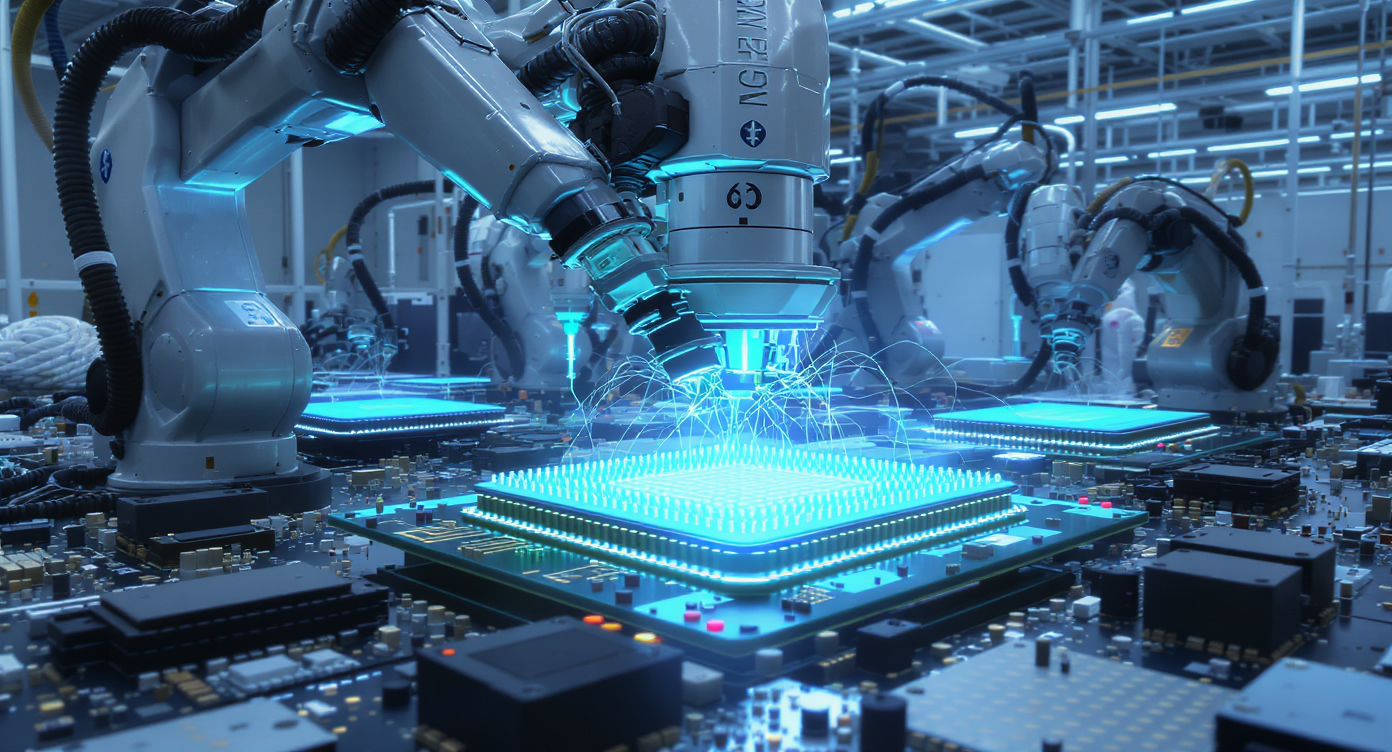
The artificial intelligence revolution has reached a critical juncture. As companies worldwide race to integrate AI capabilities into their products and services, a perfect storm is brewing in the semiconductor industry. AI chip demand has skyrocketed by an unprecedented 300%, creating a global supply crisis that threatens to reshape entire industries and redefine competitive advantages across sectors.
This supply shortage isn’t just another temporary market hiccup—it’s a fundamental shift that’s forcing businesses to reconsider their AI strategies, accelerating innovation in chip design, and potentially determining which companies will lead the next decade of technological advancement.
The numbers paint a stark picture. Major AI chip manufacturers are reporting order backlogs stretching 12-18 months into the future, while spot market prices for high-end AI processors have increased by 150-200% in some regions. From data centers to autonomous vehicles, from smartphones to smart home devices, the ripple effects of this crisis are being felt across every corner of the digital economy.
The Perfect Storm: What’s Driving Unprecedented AI Chip Demand
Several converging factors have created this supply-demand imbalance, with generative AI leading the charge. The explosive popularity of ChatGPT, which gained 100 million users in just two months, triggered an arms race among tech giants to develop their own large language models. Each of these models requires thousands of specialized AI chips for both training and inference operations.
Enterprise AI adoption has accelerated beyond all predictions. McKinsey’s latest research shows that 65% of organizations are now using generative AI regularly, up from just 20% twelve months ago. This rapid adoption means companies that previously had no AI infrastructure suddenly need substantial computing power to remain competitive.
The cloud computing boom continues to fuel demand as hyperscale data centers expand their AI capabilities. Amazon Web Services, Microsoft Azure, and Google Cloud are investing billions in new data centers specifically designed for AI workloads, each requiring tens of thousands of AI chips.
Meanwhile, edge AI applications are multiplying rapidly. Modern smartphones, autonomous vehicles, industrial IoT devices, and smart city infrastructure all require AI processing capabilities at the point of use, rather than relying solely on cloud-based processing. This distributed approach to AI computing has created entirely new market segments overnight.
The automotive industry represents perhaps the most dramatic example of this shift. Electric vehicles now contain an average of 3-5 AI chips compared to virtually zero just five years ago. With global EV sales projected to reach 30 million units by 2025, the automotive sector alone could consume more AI chips than the entire industry produced in 2020.
Supply Chain Bottlenecks: The Manufacturing Reality Check
The semiconductor industry’s complex supply chain was already strained before AI demand exploded. Manufacturing capacity constraints represent the most significant bottleneck. Advanced AI chips require cutting-edge fabrication processes, with most high-performance processors manufactured using 7nm, 5nm, or 3nm process technologies.
Only three companies worldwide—TSMC, Samsung, and Intel—possess the advanced manufacturing capabilities needed for these processes. TSMC, which produces chips for NVIDIA, Apple, and AMD, currently controls approximately 60% of the global advanced chip manufacturing market. This concentration of manufacturing capability creates inherent supply constraints that cannot be quickly resolved.
Raw material shortages compound the manufacturing challenges. Silicon wafers, rare earth elements, and specialized chemicals required for chip production have all experienced supply disruptions. The COVID-19 pandemic initially triggered these shortages, but geopolitical tensions and export restrictions have prolonged and intensified them.
The complexity of AI chip design adds another layer of difficulty. Unlike traditional processors, AI chips require specialized architectures optimized for machine learning workloads. These chips often feature thousands of processing cores, high-bandwidth memory interfaces, and complex interconnect systems. The design and testing phases alone can take 18-24 months before manufacturing even begins.
Geographic concentration of supply chain elements creates additional vulnerabilities. Over 80% of advanced semiconductor manufacturing occurs in East Asia, primarily in Taiwan, South Korea, and China. Recent geopolitical tensions have highlighted the risks of this concentration, prompting governments and companies to consider supply chain diversification—but such changes take years to implement.
Quality control requirements for AI chips are exceptionally stringent. These processors often run continuously at high utilization rates in data centers and mission-critical applications. A single faulty chip can compromise entire AI systems, making thorough testing essential but time-consuming.
Industry Impact: Winners, Losers, and Strategic Adaptations
The AI chip shortage is creating clear winners and losers across industries, while forcing companies to develop new strategies for managing semiconductor supply chains.
Technology giants with existing chip inventory or direct manufacturer relationships maintain significant advantages. Companies like Google, Amazon, and Meta have invested heavily in custom AI chip development, reducing their dependence on third-party suppliers. Google’s TPU (Tensor Processing Unit) chips and Amazon’s Graviton processors provide these companies with dedicated AI computing resources unavailable to competitors.
NVIDIA has emerged as the primary beneficiary of the AI boom, with their H100 and A100 chips becoming the gold standard for AI training and inference. The company’s stock price has increased over 400% in the past two years, largely driven by AI chip demand. However, even NVIDIA struggles to meet demand, with delivery times extending 6-12 months for large orders.
Startups and smaller companies face the greatest challenges. Without the purchasing power or strategic relationships of tech giants, these organizations often cannot access the AI computing resources needed to compete effectively. Many are turning to cloud-based AI services as an alternative to purchasing hardware directly, but this approach can become prohibitively expensive for large-scale applications.
Traditional industries are being forced to reconsider their digitization timelines. Automotive manufacturers have delayed new model launches due to chip shortages, while consumer electronics companies have simplified product designs to reduce semiconductor requirements.
Smart strategic adaptations are emerging across sectors. Some companies are investing in chip pre-purchasing agreements, essentially financing manufacturer capacity expansion in exchange for guaranteed future supply. Others are redesigning products to use less advanced chips or developing hybrid architectures that combine traditional processors with specialized AI accelerators.
Software optimization has become a critical competitive advantage. Companies that can extract maximum performance from available hardware gain significant advantages over competitors requiring more computational resources for equivalent results. This has sparked renewed interest in efficient AI algorithms and model compression techniques.
The shortage has also accelerated alternative architecture development. Neuromorphic chips, which mimic brain structures, and quantum processing units represent potential long-term alternatives to traditional AI chips, though these technologies remain in early development stages.
Future Outlook: Navigation Strategies for the New Reality
The AI chip supply crisis will likely persist through 2025, but companies can take concrete steps to navigate this challenging environment and position themselves for future success.
Diversification strategies are becoming essential. Rather than relying on single suppliers or chip architectures, successful companies are developing multi-vendor strategies that provide flexibility and reduce supply risk. This might mean using NVIDIA chips for training workloads while employing Intel or AMD processors for inference tasks.
Inventory management requires new approaches in this environment. Companies are shifting from just-in-time delivery models to strategic stockpiling of critical components. However, this approach requires careful balance—excess inventory ties up capital and risks obsolescence as chip technology evolves rapidly.
Cloud partnerships offer practical alternatives for many organizations. Rather than purchasing and managing AI hardware directly, companies can leverage cloud providers’ massive purchasing power and technical expertise. This approach provides access to cutting-edge AI capabilities without the supply chain complexities, though it may increase long-term costs and reduce control over AI infrastructure.
Investment in software efficiency provides immediate returns. Optimizing AI models and algorithms to run more efficiently on available hardware can effectively multiply computing capacity. Techniques like model quantization, pruning, and knowledge distillation can reduce computational requirements by 50-80% while maintaining acceptable performance levels.
Regional supply chain development is gaining momentum as governments recognize the strategic importance of semiconductor manufacturing. The US CHIPS Act, European Chips Act, and similar initiatives worldwide are investing hundreds of billions in domestic chip manufacturing capacity. While these investments won’t resolve current shortages, they should improve supply security within 3-5 years.
Collaborative approaches are proving valuable for smaller companies. Industry consortiums and shared AI infrastructure projects allow multiple organizations to pool resources and share access to scarce computing capacity.
The companies that successfully navigate this crisis will likely employ hybrid strategies combining multiple approaches. They’ll maintain diverse supplier relationships, optimize software efficiency, leverage cloud resources strategically, and invest in emerging technologies that could provide competitive advantages as supply constraints eventually ease.
Looking ahead, this supply crisis may ultimately prove beneficial for the industry’s long-term development. The current constraints are driving innovation in chip design, manufacturing processes, and AI algorithms. Companies are being forced to use resources more efficiently and think more strategically about their technology investments.
The AI chip supply crisis represents both a significant challenge and a defining moment for businesses across all sectors. Companies that adapt quickly and strategically will emerge stronger and better positioned for the AI-driven future, while those that fail to adjust may find themselves permanently disadvantaged.
How is your organization preparing for the ongoing AI chip shortage, and what strategies are you implementing to ensure continued access to the computing power needed for your AI initiatives?
Comments