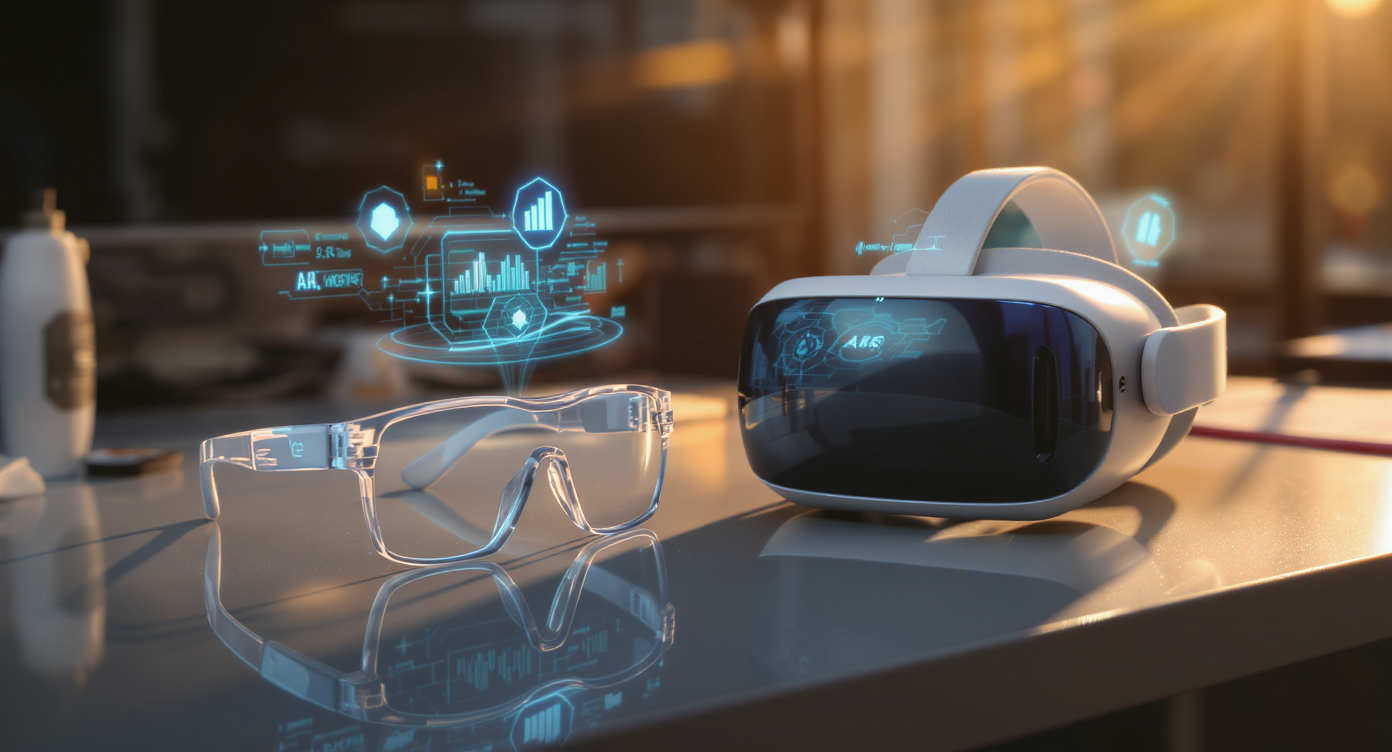
The augmented reality landscape is about to witness its most significant battle yet. Meta’s ambitious Orion AR glasses project is positioning itself as a direct challenger to Apple’s Vision Pro, with both tech giants racing toward a 2026 showdown that could define the future of mixed reality computing.
While Apple’s Vision Pro launched to considerable fanfare in 2024, Meta has been quietly developing what could be the game-changing alternative. The Orion glasses represent Meta’s bold vision of true augmented reality—lightweight, everyday wearable glasses that seamlessly blend digital content with the physical world, rather than the bulky headset approach of current VR/AR devices.
This brewing competition isn’t just about hardware specifications; it’s a fundamental clash of philosophies about how humans will interact with digital content in the coming decade. Apple’s premium, feature-rich Vision Pro targets early adopters and professionals, while Meta’s Orion aims for mass-market accessibility and all-day wearability.
Meta’s Orion: The Promise of True AR Glasses
Meta’s Orion represents a dramatic departure from the company’s previous VR-focused Quest lineup. Unlike the Vision Pro’s mixed reality approach, Orion is designed as true augmented reality glasses that overlay digital information directly onto your field of view without blocking out the real world.
The technical challenges Meta faces are immense. Creating lightweight glasses that can project high-quality digital content while maintaining all-day battery life requires breakthrough innovations in display technology, processing power, and thermal management. Early prototypes reportedly use advanced waveguide displays and custom silicon designed specifically for AR applications.
What sets Orion apart from competitors is Meta’s focus on social interaction and connectivity. The glasses are expected to integrate deeply with Meta’s social platforms, enabling users to share AR experiences, collaborate in virtual workspaces, and communicate through spatial interfaces that feel natural and intuitive.
The company’s Reality Labs division has invested over $50 billion in metaverse technologies since 2019, with much of that research directly contributing to Orion’s development. This massive investment suggests Meta is betting its future on AR glasses becoming the next major computing platform, much like smartphones revolutionized personal technology in the 2000s.
Key features expected in Orion include:
- Ultra-lightweight design under 100 grams
- All-day battery life through advanced power management
- High-resolution displays with wide field of view
- Advanced hand and eye tracking
- Seamless integration with smartphones and computers
- AI-powered contextual information overlay
Apple Vision Pro: Setting the Premium Standard
Apple’s Vision Pro took a different approach, launching as a premium mixed reality headset that combines augmented and virtual reality capabilities. Priced at $3,499, the Vision Pro established itself as the luxury option in the emerging spatial computing market, targeting professionals, developers, and tech enthusiasts willing to pay for cutting-edge technology.
The Vision Pro’s strengths lie in its exceptional display quality, sophisticated eye-tracking interface, and seamless integration with Apple’s ecosystem. Users can run familiar apps in three-dimensional space, collaborate on complex projects, and consume media in ways previously impossible. The device’s M2 chip and custom R1 processor deliver performance that was unimaginable in portable form factors just a few years ago.
However, the Vision Pro’s limitations are equally apparent. Its weight, battery life, and social isolation have drawn criticism from users who expected a more comfortable, everyday experience. The device works best for focused, seated activities rather than mobile, all-day use that true AR glasses promise to enable.
Apple’s approach reflects the company’s traditional strategy of entering markets with premium products that establish new quality standards before expanding to broader audiences. The Vision Pro serves as a technology showcase and developer platform while Apple likely works on lighter, more affordable versions for mass market adoption.
By 2026, Apple is expected to release updated versions of the Vision Pro with improved ergonomics, longer battery life, and potentially lower pricing to compete directly with Meta’s Orion glasses.
The Technology Race: Innovation Battlegrounds
The competition between Meta and Apple centers on several critical technology areas where breakthrough innovations will determine market success.
Display Technology represents the most significant challenge. Both companies are investing heavily in micro-LED displays, advanced optics, and waveguide technologies that can deliver sharp, bright images while maintaining the lightweight form factor essential for all-day wear. Meta’s approach focuses on transparent displays that preserve natural vision, while Apple’s current technology relies on cameras and passthrough video.
Processing Power and Efficiency pose another major hurdle. AR glasses must perform complex computations for tracking, rendering, and AI processing while managing heat and power consumption. Meta is reportedly developing custom chips optimized specifically for AR workloads, while Apple leverages its proven expertise in mobile processor design.
Battery Life could determine which device wins mainstream adoption. Current AR and VR devices struggle with power management, requiring frequent charging or external battery packs. The company that solves all-day battery life in a lightweight package will have a significant competitive advantage.
User Interface Innovation may prove most critical for mass market success. Apple’s eye-tracking and gesture controls in the Vision Pro represent significant advances, but true AR glasses need even more intuitive interaction methods. Both companies are exploring voice commands, subtle hand gestures, and AI-powered contextual interfaces that respond to user intent without explicit commands.
Ecosystem Integration will leverage each company’s existing strengths. Apple’s tight hardware-software integration and loyal user base provide advantages in delivering polished, cohesive experiences. Meta’s social platform expertise and developer relationships could accelerate AR content creation and social features that make the technology compelling for everyday users.
Market Impact and Consumer Adoption Challenges
The success of both platforms depends on overcoming significant consumer adoption barriers that have historically limited AR and VR growth. Price sensitivity remains crucial—Meta’s mass-market approach with Orion could reach broader audiences if the company can deliver compelling experiences at accessible price points.
Privacy concerns present unique challenges for both companies, particularly for devices that continuously capture and analyze the user’s environment. Meta faces additional skepticism due to past privacy controversies, while Apple’s strong privacy reputation could provide competitive advantages in gaining consumer trust.
Content availability will determine whether either platform achieves sustainable success. Both companies are investing heavily in developer tools, content creation platforms, and first-party applications to ensure users have compelling reasons to adopt AR glasses beyond novelty appeal.
Professional and enterprise markets offer potentially lucrative opportunities for both platforms. Apple’s Vision Pro has already gained traction in industries like design, training, and collaboration, while Meta’s focus on social and communication features could appeal to different professional use cases.
The 2026 timeframe allows both companies to refine their technologies and learn from current-generation limitations. Consumer expectations will also evolve as early AR/VR experiences become more familiar and users develop clearer preferences for how they want to interact with spatial computing technologies.
The competition between Meta’s Orion and Apple’s Vision Pro evolution represents more than just another tech product battle—it’s a defining moment for the future of human-computer interaction. Success will require not just technological innovation but also solving complex challenges around user experience, content ecosystems, and social acceptance of wearable computing devices.
What features do you think will be most important for AR glasses to achieve mainstream adoption, and which company’s approach seems more likely to succeed in the mass market?

Comments