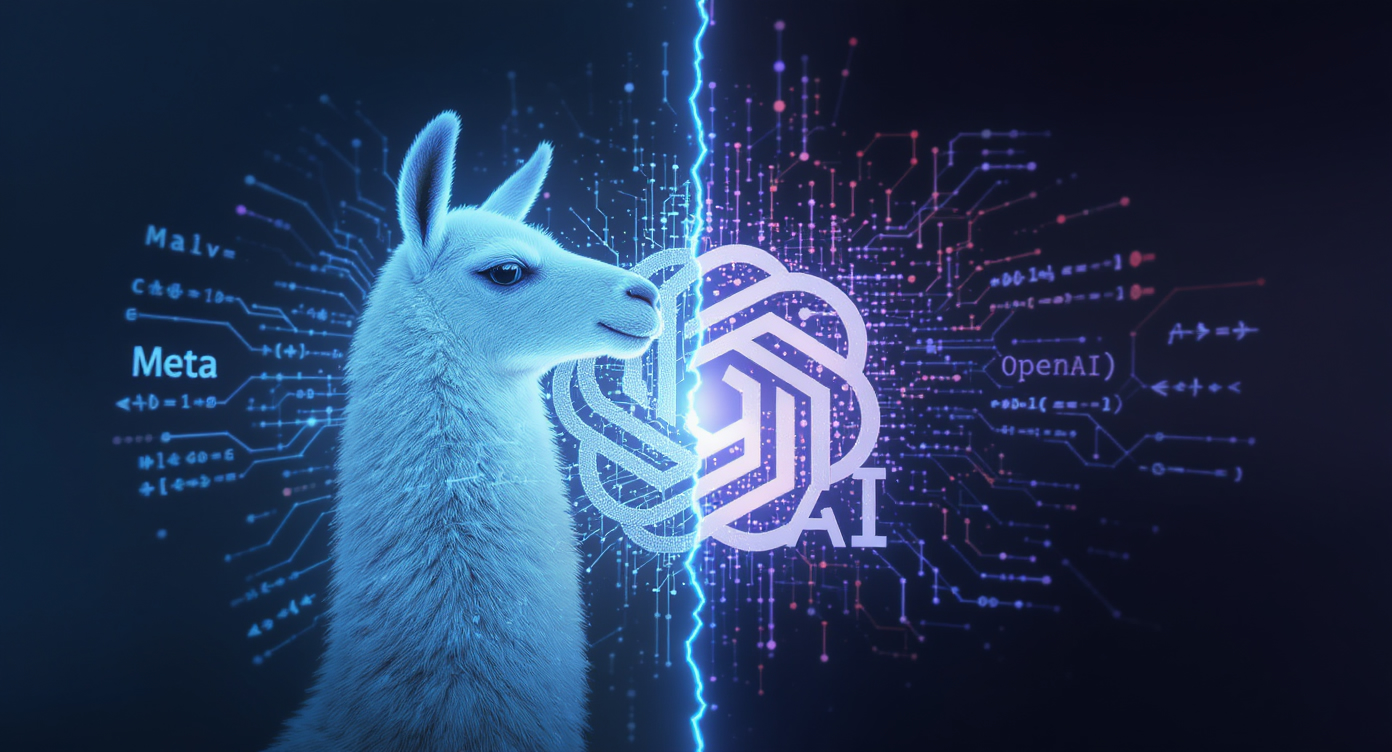
The artificial intelligence landscape is witnessing an unprecedented race to the top, with tech giants pushing the boundaries of what’s possible in machine reasoning. Meta’s latest announcement of Llama 4 has sent shockwaves through the AI community, positioning itself as a formidable challenger to OpenAI’s anticipated GPT-5. This development marks a pivotal moment in AI evolution, where reasoning capabilities—not just language generation—take center stage.
As businesses and developers worldwide seek more sophisticated AI solutions, the competition between these flagship models promises to accelerate innovation and reshape how we interact with artificial intelligence. Meta’s strategic push into advanced reasoning represents more than just technological advancement; it signals a fundamental shift in how AI systems will solve complex problems across industries.
Llama 4’s Revolutionary Reasoning Architecture
Meta has completely reimagined its approach to AI reasoning with Llama 4, implementing what they call “multi-step cognitive processing”—a system that mirrors human-like thinking patterns more closely than ever before. Unlike previous iterations that primarily excelled at pattern recognition and text generation, Llama 4 demonstrates remarkable capabilities in breaking down complex problems into manageable components.
The model’s architecture incorporates several groundbreaking features that set it apart from its predecessors:
Advanced Chain-of-Thought Processing: Llama 4 doesn’t just provide answers; it shows its work. The model can articulate its reasoning process step-by-step, making it invaluable for applications requiring transparency and explainability. This feature proves particularly crucial in sectors like healthcare, finance, and legal services where understanding the “why” behind decisions is paramount.
Dynamic Context Adaptation: Perhaps most impressively, Llama 4 can adjust its reasoning approach based on the complexity and nature of the task at hand. When faced with mathematical problems, it employs logical deduction; for creative challenges, it leverages associative thinking; and for analytical tasks, it applies systematic evaluation methods.
Memory Integration: The model maintains context across extended conversations while building upon previous interactions to inform current reasoning. This persistent memory capability allows for more nuanced and contextually aware responses that improve over time.
Early benchmark tests suggest that Llama 4 outperforms GPT-4 in several reasoning categories, including mathematical problem-solving, logical deduction, and multi-step planning tasks. Beta testers report that the model demonstrates an almost human-like ability to recognize when it needs more information and ask clarifying questions—a significant leap forward in AI interaction quality.
Head-to-Head: Llama 4 vs GPT-5 Capabilities
The competition between Llama 4 and GPT-5 represents more than just a battle of features—it’s a clash of philosophical approaches to artificial intelligence development. While specific GPT-5 capabilities remain under wraps, industry insiders and leaked benchmarks provide insight into how these titans compare.
Reasoning Speed and Efficiency: Llama 4’s optimized architecture allows it to process complex reasoning tasks up to 40% faster than comparable models, while GPT-5 is expected to focus on more thorough, albeit slower, deliberative processing. This difference could prove crucial for real-time applications where quick decision-making is essential.
Domain Specialization: Meta has trained Llama 4 with enhanced focus on STEM fields, business analytics, and code generation, showing particular strength in areas requiring logical progression and systematic thinking. GPT-5, based on OpenAI’s historical approach, likely maintains broader general knowledge with more balanced performance across diverse domains.
Integration and Accessibility: One of Llama 4’s most significant advantages lies in its open-source nature and flexible deployment options. Unlike GPT-5, which will likely remain behind OpenAI’s API walls, Llama 4 offers organizations the ability to fine-tune and deploy the model on their own infrastructure, providing greater control over data privacy and customization.
Multimodal Reasoning: Both models promise advanced multimodal capabilities, but early demonstrations suggest different strengths. Llama 4 excels at reasoning about visual data in technical contexts—analyzing charts, diagrams, and scientific imagery—while GPT-5 appears to focus more on creative and conversational multimodal interactions.
The benchmark wars have already begun, with Llama 4 showing superior performance on the MATH dataset (achieving 89.2% accuracy compared to GPT-4’s 76.6%) and the HumanEval coding benchmark. However, GPT-5’s performance metrics remain largely speculative until official release.
Real-World Applications and Industry Impact
The enhanced reasoning capabilities of Llama 4 are already finding practical applications across multiple industries, demonstrating the model’s potential to revolutionize how businesses approach problem-solving and decision-making processes.
Financial Services Revolution: Investment firms are leveraging Llama 4’s analytical reasoning to process complex market data, identify patterns, and generate investment strategies. Unlike traditional AI models that rely heavily on historical pattern matching, Llama 4 can reason through novel market conditions and provide explanations for its recommendations that satisfy regulatory requirements.
Healthcare Diagnostic Support: Medical institutions are piloting Llama 4 for diagnostic assistance, where the model’s ability to reason through symptoms, medical history, and test results proves invaluable. The model’s transparency in showing its diagnostic reasoning helps healthcare professionals understand and validate AI-assisted decisions, leading to better patient outcomes.
Software Development Acceleration: Development teams report significant productivity gains using Llama 4 for code review, debugging, and architecture planning. The model doesn’t just identify issues—it explains why they occur and suggests multiple solution approaches, helping developers learn and improve their skills simultaneously.
Educational Transformation: Educational technology companies are integrating Llama 4 to create personalized tutoring systems that adapt their teaching approach based on individual student reasoning patterns. The model can identify knowledge gaps and adjust explanations accordingly, mimicking the best human tutors.
Legal Research and Analysis: Law firms are deploying Llama 4 for case research and legal brief preparation, where the model’s ability to reason through complex legal precedents and identify relevant connections dramatically reduces research time while improving thoroughness.
The competitive pressure from Llama 4 has also accelerated innovation across the industry. Companies previously dependent on OpenAI’s solutions now have viable alternatives, leading to more competitive pricing and rapid feature development across all major AI providers.
Strategic Implications for Businesses and Developers
The emergence of Llama 4 as a serious competitor to GPT-5 creates both opportunities and challenges for organizations planning their AI strategies. Understanding these implications is crucial for making informed technology investments.
Cost and Control Considerations: Llama 4’s open-source nature offers significant long-term cost advantages for organizations with sufficient technical infrastructure. While initial setup and maintenance require more expertise than using OpenAI’s hosted services, the ability to run models locally eliminates per-token costs and provides complete control over data processing.
Talent and Skills Gap: Organizations considering Llama 4 implementation must assess their technical capabilities honestly. While the model offers greater customization potential, it also requires specialized knowledge in model deployment, fine-tuning, and maintenance—skills that remain scarce in the current job market.
Innovation Speed: The competition between Meta and OpenAI is accelerating the pace of AI advancement dramatically. Organizations must build flexible AI architectures that can adapt to rapid model improvements and changing capabilities rather than betting entirely on a single provider.
Risk Management: Diversifying AI dependencies across multiple providers reduces risks associated with service disruptions, policy changes, or competitive disadvantages. Smart organizations are developing multi-model strategies that leverage the strengths of different AI systems.
Industry-Specific Applications: Companies should evaluate which model aligns better with their specific use cases. Llama 4’s strength in reasoning and analysis makes it ideal for technical and analytical applications, while GPT-5 may prove superior for creative and conversational use cases.
The strategic landscape is further complicated by regulatory considerations, as governments worldwide develop frameworks for AI governance. Organizations must consider how their AI choices align with emerging compliance requirements and ethical guidelines.
Looking ahead, the success of Llama 4 versus GPT-5 will likely depend not just on technical capabilities but on ecosystem development, community support, and practical implementation success stories. Both models represent significant advances in AI reasoning, and the competition between them promises to benefit users through continued innovation and improved capabilities.
As we stand at this inflection point in AI development, one question emerges as particularly critical: How will your organization adapt its AI strategy to leverage these advancing reasoning capabilities while maintaining competitive advantage in an rapidly evolving landscape?

Comments