
Meta’s Strategic Move into AI Chip Manufacturing
The artificial intelligence chip market has long been dominated by NVIDIA, whose GPUs have powered everything from gaming to machine learning applications. However, Meta’s recent announcement of its custom AI chips signals a significant shift in the semiconductor landscape, potentially reshaping how major tech companies approach AI infrastructure and challenging NVIDIA’s stronghold on the market.
Meta’s entry into the AI chip arena isn’t merely about cost reduction—it represents a fundamental strategic pivot toward vertical integration and technological independence. As the metaverse company continues expanding its AI capabilities across social media platforms, virtual reality experiences, and large language models, the need for specialized, optimized hardware has become critical for maintaining competitive advantage.
The implications extend far beyond Meta’s internal operations. This move could catalyze a broader industry trend where major tech companies develop proprietary silicon solutions, fundamentally altering the dynamics of AI chip procurement and potentially democratizing access to high-performance computing resources.
Understanding Meta’s AI Chip Architecture
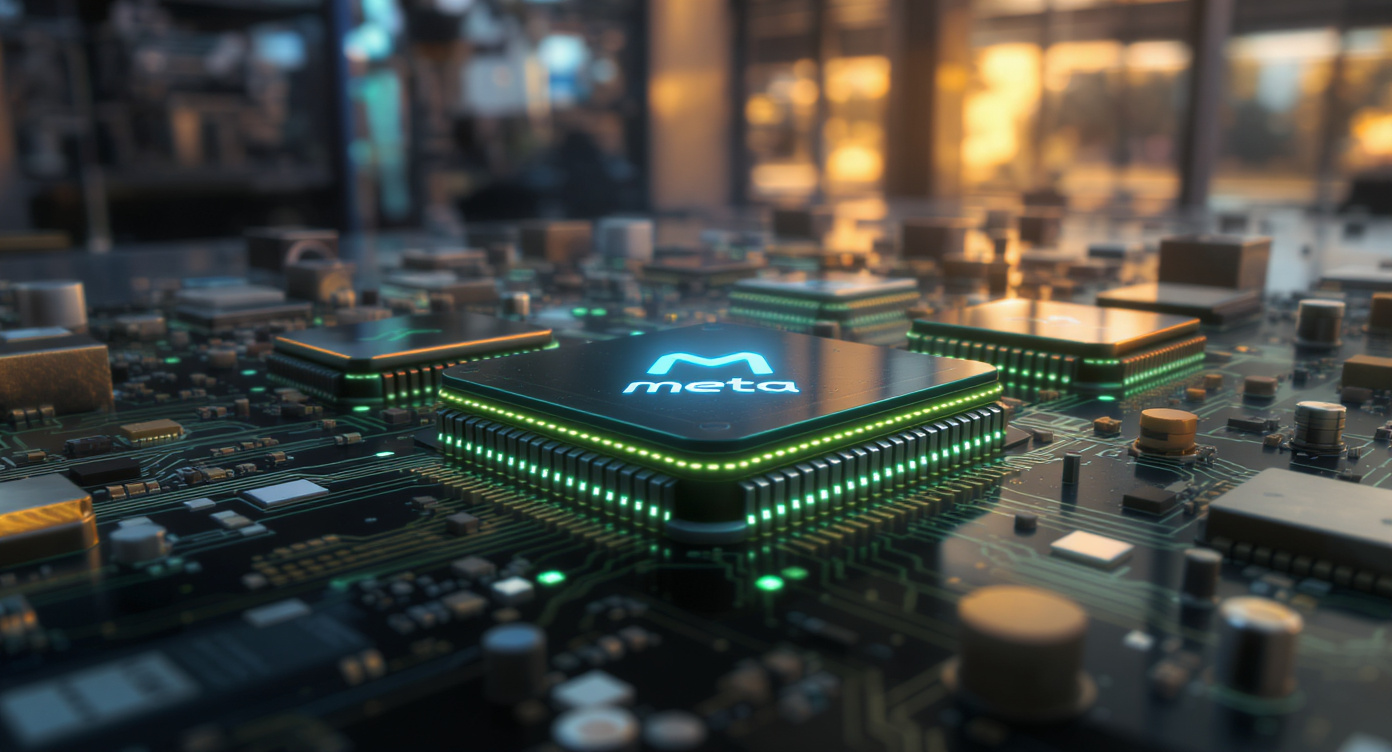
Meta’s custom AI chips, designed specifically for training and inference workloads, represent years of internal research and development. These chips prioritize efficiency in handling the company’s unique computational requirements, from content recommendation algorithms to advanced computer vision tasks powering augmented reality features.
Key Technical Specifications:
- Specialized Matrix Operations: Optimized for transformer-based neural networks
- Memory Bandwidth: Enhanced data throughput for large-scale model training
- Power Efficiency: Reduced energy consumption compared to general-purpose GPUs
- Scalability: Designed for Meta’s specific cluster configurations
The architecture focuses heavily on tensor processing units (TPUs) similar to Google’s approach, but with modifications tailored to Meta’s specific AI workloads. Unlike NVIDIA’s versatile GPU architecture that serves multiple markets, Meta’s chips prioritize narrow optimization for social media AI tasks, potentially delivering superior performance per watt in these specific applications.
What sets Meta’s approach apart is the integration with their software stack. By controlling both hardware and software layers, Meta can optimize performance in ways that third-party chip manufacturers cannot match. This vertical integration allows for fine-tuned optimizations that could provide significant competitive advantages in AI model training speed and inference efficiency.
The chips also incorporate advanced memory hierarchies designed to handle the massive datasets typical of social media platforms. With billions of users generating content continuously, Meta’s AI systems must process unprecedented amounts of data in real-time, making memory bandwidth and latency critical performance factors.
Impact on NVIDIA’s Market Position
NVIDIA’s dominance in the AI chip market has been built on the versatility of its GPU architecture and the robust CUDA ecosystem that developers worldwide have embraced. However, Meta’s move represents the most significant challenge to this dominance since the AI boom began.
Market Share Implications:
The AI chip market, valued at approximately $67 billion in 2023, has seen NVIDIA capture roughly 80% of the data center GPU market. Meta’s internal chip development could reduce NVIDIA’s revenue from one of its largest customers while simultaneously demonstrating to other tech giants that alternatives exist.
Competitive Pressure Points:
- Pricing Power: Meta’s success with custom chips may pressure NVIDIA to offer more competitive pricing
- Innovation Pace: Increased competition typically accelerates technological advancement
- Market Segmentation: Specialized chips may fragment NVIDIA’s unified market approach
However, NVIDIA’s position isn’t immediately threatened. The company’s extensive software ecosystem, including CUDA, cuDNN, and TensorRT, creates significant switching costs for developers. Additionally, NVIDIA serves diverse markets beyond social media AI, including autonomous vehicles, scientific computing, and gaming.
The real challenge for NVIDIA lies in the potential demonstration effect. If Meta achieves substantial performance gains or cost reductions with custom chips, other tech giants like Amazon, Microsoft, and Apple may accelerate their own chip development programs. This could transform NVIDIA from a growth company benefiting from explosive AI demand into a more mature company competing in a fragmented market.
Strategic Response Options:
NVIDIA has several potential responses to this challenge, including developing more specialized chip variants, enhancing software tools, or pursuing strategic partnerships. The company’s recent focus on software and services suggests recognition that hardware commoditization risks exist.
Strategic Implications for the Tech Industry
Meta’s chip development initiative reflects broader industry trends toward vertical integration and technological sovereignty. This shift has profound implications for how technology companies approach infrastructure investments and competitive strategy.
Supply Chain Independence:
The global chip shortage exposed vulnerabilities in relying on external suppliers for critical components. Meta’s move toward internal chip development provides greater control over supply chains and reduces dependency on external vendors for strategic technologies.
Cost Optimization at Scale:
For companies with Meta’s scale, internal chip development can deliver substantial cost advantages. While initial development costs are significant, the per-unit economics become favorable when deploying millions of chips across global data centers.
Competitive Moats:
Custom chips create unique competitive advantages that competitors cannot easily replicate. Meta’s AI capabilities could become differentiated through superior hardware optimization, making it difficult for competitors to match performance levels using off-the-shelf components.
Industry Ecosystem Changes:
This trend toward custom chips may reshape the semiconductor ecosystem. Traditional chip companies may need to pivot toward providing design services, manufacturing capabilities, or specialized components rather than complete solutions.
Innovation Acceleration:
Competition in AI chips should accelerate innovation across the industry. As companies develop specialized solutions for their unique requirements, the pace of technological advancement in AI hardware is likely to increase significantly.
Talent Wars:
The competition for semiconductor design talent is intensifying as tech companies build internal chip teams. This trend may drive up compensation costs while potentially slowing progress as talent becomes more distributed across companies.
Future Outlook and Market Evolution
The AI chip market is entering a new phase characterized by increased competition, specialization, and vertical integration. Meta’s entry represents just the beginning of a broader transformation that could reshape the entire semiconductor industry.
Short-term Developments (1-2 years):
- Meta will likely expand chip production and deployment across its data centers
- Other tech giants may announce similar custom chip initiatives
- NVIDIA may introduce more specialized product variants to compete with custom solutions
- Performance benchmarks will emerge comparing custom chips to traditional GPUs
Medium-term Trends (3-5 years):
- Market fragmentation as specialized chips address specific AI workloads
- Potential emergence of new players offering design services for custom chips
- Evolution of software frameworks to support diverse chip architectures
- Possible consolidation among traditional chip companies facing reduced demand
Long-term Implications (5+ years):
The ultimate outcome depends largely on whether custom chips deliver sufficient advantages to justify their development costs. If Meta and others achieve significant performance or cost benefits, the market could evolve toward a model where major tech companies develop internal chips while smaller companies rely on specialized chip providers.
Key Success Factors:
For Meta’s chip initiative to succeed long-term, several factors are crucial:
- Demonstrable performance advantages over NVIDIA alternatives
- Cost-effective scaling of chip production
- Successful integration with existing AI software frameworks
- Ability to iterate and improve chip designs based on real-world performance data
The broader industry will be watching Meta’s progress closely. Success could validate the custom chip approach and encourage more companies to pursue similar strategies, while failure might reinforce NVIDIA’s market position and demonstrate the challenges of internal chip development.
Regulatory Considerations:
Government policies around semiconductor manufacturing and AI development could significantly impact this market evolution. Trade restrictions, manufacturing incentives, and AI regulations may all influence how companies approach chip development strategies.
The competition between Meta’s custom AI chips and NVIDIA’s established solutions represents more than a simple vendor rivalry—it’s a fundamental shift in how the technology industry approaches AI infrastructure. As this competition unfolds, it will likely drive innovation, reduce costs, and ultimately benefit consumers through improved AI applications and services.
What do you think will be the most significant long-term impact of tech giants developing their own AI chips rather than relying on traditional semiconductor companies?


Comments