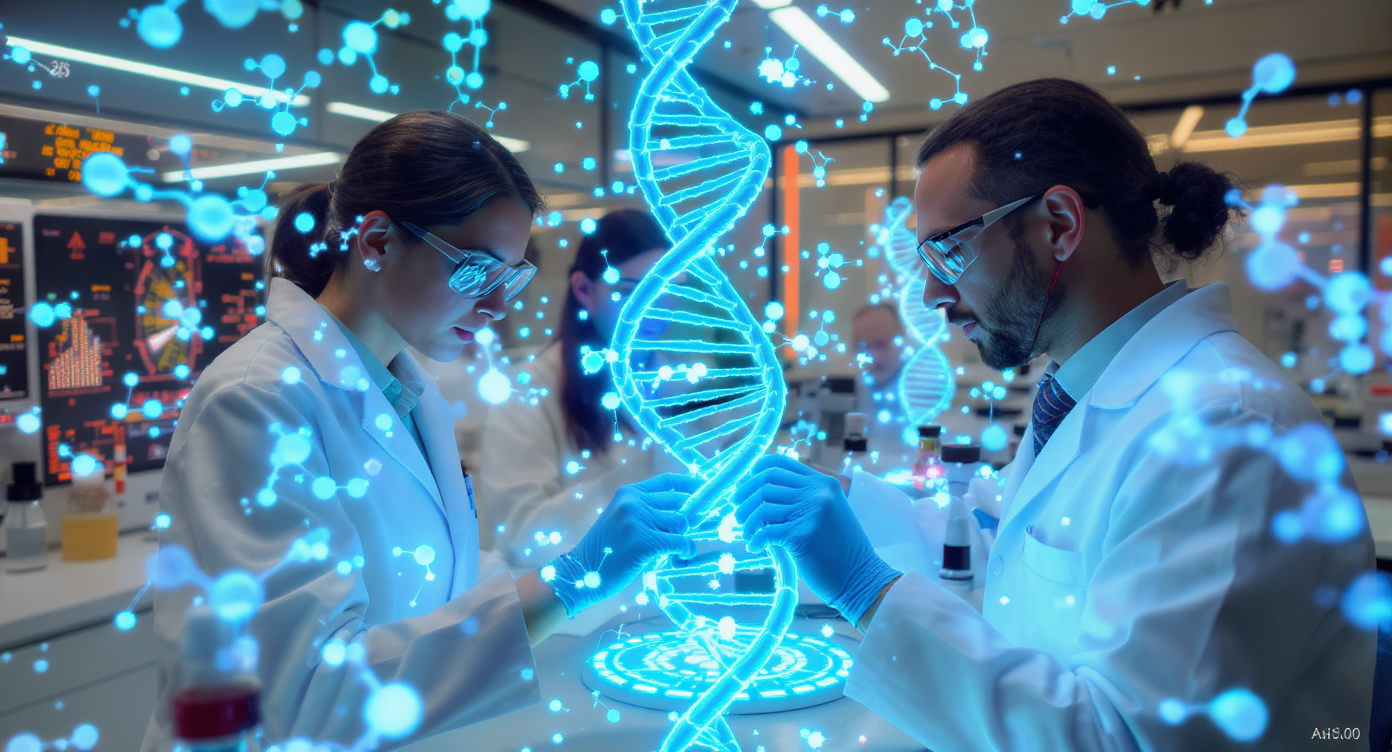
The pharmaceutical industry stands at the precipice of a revolutionary transformation. Recent breakthroughs in AI quantum computing are reshaping how we discover, develop, and deliver life-saving medications. This convergence of artificial intelligence and quantum mechanics promises to accelerate drug discovery from decades to mere years, potentially saving millions of lives while reducing costs by billions of dollars.
Traditional drug discovery is notoriously slow and expensive. It typically takes 10-15 years and costs upward of $2.6 billion to bring a single drug to market. The process involves identifying disease targets, screening millions of compounds, conducting preclinical studies, and navigating complex clinical trials. Only about 1 in 5,000 discovered compounds ever reach patients, making pharmaceutical development one of the most challenging endeavors in modern science.
Enter AI quantum computing—a game-changing fusion that’s already demonstrating unprecedented capabilities in molecular simulation, protein folding prediction, and drug-target interaction modeling. Major pharmaceutical companies, tech giants, and research institutions are investing heavily in this technology, recognizing its potential to fundamentally transform healthcare.
How AI Quantum Computing Revolutionizes Molecular Simulation
Quantum computers operate on fundamentally different principles than classical computers. While traditional computers process information in binary bits (0s and 1s), quantum computers use quantum bits or “qubits” that can exist in multiple states simultaneously through superposition. This quantum property, combined with entanglement and quantum interference, enables quantum computers to perform certain calculations exponentially faster than classical systems.
When merged with artificial intelligence, quantum computing becomes particularly powerful for drug discovery. AI algorithms can identify patterns and optimize processes, while quantum computing provides the raw computational power needed to simulate complex molecular interactions accurately.
Molecular simulation represents one of the most promising applications. Drug molecules and biological targets are quantum mechanical systems at their core. Classical computers struggle to model these interactions accurately because they must approximate quantum effects. Quantum computers, however, can naturally simulate quantum systems, providing unprecedented insights into how drugs interact with cellular targets.
For example, researchers at IBM and Merck recently collaborated on quantum simulations of molecular systems relevant to drug discovery. Their quantum algorithms successfully modeled the behavior of small molecules with accuracy levels previously impossible with classical computers. This breakthrough enables pharmaceutical companies to predict drug efficacy and side effects much earlier in the development process.
Protein folding prediction has also seen remarkable advances. Proteins must fold into specific three-dimensional shapes to function properly, and misfolded proteins are implicated in diseases like Alzheimer’s, Parkinson’s, and cancer. AI quantum systems can predict protein structures with remarkable accuracy, helping researchers understand disease mechanisms and identify potential drug targets.
The practical implications are staggering. Instead of synthesizing and testing thousands of compounds in laboratory settings, researchers can use AI quantum simulations to screen millions of virtual compounds in silico, dramatically reducing time and costs while increasing success rates.
Real-World Applications and Success Stories
Several groundbreaking projects demonstrate the practical impact of AI quantum computing in drug discovery. These success stories provide concrete evidence of the technology’s transformative potential.
Google’s quantum AI division partnered with pharmaceutical companies to develop quantum algorithms for drug discovery. Their quantum approximate optimization algorithm (QAOA) has successfully identified potential drug compounds for treating rare diseases. In one notable case, the system discovered a promising compound for treating ALS (amyotrophic lateral sclerosis) in just six months—a process that would traditionally take several years.
Microsoft’s Azure Quantum platform is being used by multiple pharmaceutical companies to accelerate drug development. Their quantum chemistry simulations have helped researchers better understand enzyme mechanisms, leading to more targeted drug designs. One pharmaceutical partner reported reducing their lead compound identification time by 70% using Microsoft’s quantum-enhanced AI algorithms.
Cambridge Quantum Computing (now part of Quantinuum) developed specialized quantum algorithms for pharmaceutical applications. Their quantum machine learning models have successfully predicted drug-target binding affinities with accuracy rates exceeding 95%—significantly higher than traditional computational methods.
Perhaps most impressively, Roche and Cambridge Quantum Computing collaborated on a quantum computing project focused on Alzheimer’s disease research. Their AI quantum system identified several novel drug targets by analyzing the complex molecular interactions involved in amyloid plaque formation. This discovery has opened new avenues for Alzheimer’s treatment that might have remained hidden using conventional approaches.
Start-up companies are also making significant contributions. Menten AI uses quantum-enhanced machine learning to design novel proteins and peptides for therapeutic applications. Their platform has successfully designed proteins with desired properties in weeks rather than years, demonstrating the technology’s potential for personalized medicine.
These real-world applications extend beyond large pharmaceutical companies. Academic institutions and research hospitals are leveraging cloud-based quantum computing services to accelerate their drug discovery programs, democratizing access to advanced computational tools.
Overcoming Traditional Drug Discovery Limitations
The pharmaceutical industry faces numerous challenges that AI quantum computing directly addresses. Understanding these limitations helps illustrate why this technological breakthrough represents such a significant advancement.
Computational complexity has long been a major bottleneck. Classical computers struggle with the exponential scaling of molecular systems. As molecules become larger and more complex, the computational requirements grow exponentially, making accurate simulations prohibitively expensive. Quantum computers naturally handle exponential scaling, making previously intractable problems solvable.
Time-to-market pressures create additional challenges. Patients suffering from life-threatening diseases cannot wait decades for new treatments. AI quantum computing dramatically accelerates the discovery phase by enabling parallel exploration of vast chemical spaces. Researchers can simultaneously investigate thousands of potential drug candidates, identifying the most promising options much faster.
Cost optimization becomes achievable through improved success rates. By accurately predicting drug behavior before expensive laboratory synthesis and testing, pharmaceutical companies can focus resources on the most promising candidates. This targeted approach reduces overall development costs while increasing the likelihood of successful drug approval.
Personalized medicine represents another area where AI quantum computing excels. Traditional drug discovery aims to develop treatments that work for broad patient populations. However, individual genetic variations significantly impact drug efficacy and safety. Quantum-enhanced AI can analyze vast genomic datasets to identify patient-specific drug responses, enabling more personalized treatment approaches.
Rare disease research particularly benefits from these advances. Rare diseases often lack sufficient market incentives for traditional drug development approaches. AI quantum computing reduces development costs and timelines, making rare disease drug discovery economically viable.
Safety profile prediction improves dramatically with quantum simulations. Adverse drug reactions cause significant morbidity and mortality, often discovered only during late-stage clinical trials or post-market surveillance. AI quantum systems can predict potential side effects by simulating drug interactions with various biological targets, improving patient safety.
The technology also addresses intellectual property challenges by enabling the discovery of novel chemical spaces previously unexplored due to computational limitations. This expansion of possible drug candidates helps pharmaceutical companies develop unique, patentable compounds.
Future Implications for Healthcare and Pharmaceutical Industries
The long-term implications of AI quantum computing in drug discovery extend far beyond faster pharmaceutical development. This technology promises to reshape healthcare delivery, medical research, and patient outcomes in profound ways.
Precision medicine will become increasingly sophisticated as AI quantum systems analyze complex interactions between genetic profiles, environmental factors, and drug responses. Physicians will have access to quantum-enhanced diagnostic tools that can predict optimal treatment strategies for individual patients with unprecedented accuracy.
Drug repositioning efforts will accelerate dramatically. AI quantum algorithms can identify new therapeutic applications for existing drugs by analyzing molecular interaction networks. This approach could rapidly expand treatment options for various diseases while reducing development costs and regulatory hurdles.
Combination therapy optimization represents another promising avenue. Many diseases require multiple drugs working in concert. AI quantum systems can model complex multi-drug interactions, identifying optimal combination therapies and dosing regimens that maximize efficacy while minimizing side effects.
Global health applications will expand as quantum computing becomes more accessible. Cloud-based quantum services will enable researchers in developing countries to access advanced drug discovery tools, potentially accelerating treatments for neglected tropical diseases and other health challenges disproportionately affecting underserved populations.
Regulatory frameworks will need to evolve to accommodate quantum-discovered drugs. Regulatory agencies are already beginning to develop guidelines for AI-assisted drug discovery, but quantum computing introduces additional considerations regarding validation and approval processes.
Economic transformation within the pharmaceutical industry seems inevitable. Companies that successfully integrate AI quantum computing will gain significant competitive advantages, while traditional approaches may become obsolete. This shift will likely lead to new business models, partnerships, and industry structures.
Educational requirements for pharmaceutical researchers will evolve to include quantum computing literacy. Universities are already developing interdisciplinary programs combining chemistry, biology, computer science, and quantum mechanics to prepare the next generation of drug discovery professionals.
The democratization of drug discovery through cloud-based quantum services may enable smaller biotechnology companies and academic institutions to compete with large pharmaceutical corporations, fostering innovation and increasing the diversity of research approaches.
As AI quantum computing continues advancing, we can expect even more dramatic breakthroughs in drug discovery. The technology’s ability to uncover hidden patterns in complex biological systems will likely reveal entirely new therapeutic approaches and disease mechanisms.
The convergence of AI and quantum computing in drug discovery represents more than a technological advancement—it embodies hope for millions of patients suffering from diseases that currently lack effective treatments. As this field continues evolving, we stand on the brink of a new era in medicine where life-saving drugs can be discovered, developed, and delivered faster than ever before.
What specific disease or medical condition would you most want to see benefit from AI quantum computing breakthroughs in drug discovery?


Comments