
Meta’s strategic pivot toward developing custom AI chips represents one of the most significant challenges to NVIDIA’s semiconductor supremacy in recent years. As the artificial intelligence arms race intensifies, Meta’s bold move to reduce dependency on external chip suppliers while optimizing performance for its specific AI workloads could fundamentally reshape the competitive landscape of AI hardware.
The social media giant’s ambitious chip development program, centered around its custom silicon initiatives, signals a broader trend among tech giants seeking greater control over their AI infrastructure. This shift comes at a crucial time when NVIDIA’s data center revenue has skyrocketed, largely driven by insatiable demand for AI processing power across industries.
Meta’s decision to challenge NVIDIA’s dominance isn’t merely about cost savings—it’s a strategic imperative that could determine the company’s ability to innovate and compete in an AI-driven future. By developing specialized chips tailored to its unique requirements, Meta aims to achieve superior performance, energy efficiency, and cost-effectiveness while reducing supply chain vulnerabilities that have plagued the tech industry.
Meta’s Custom Silicon Journey: From Vision to Reality
Meta’s foray into custom chip development began several years ago with the recognition that off-the-shelf solutions couldn’t fully address the company’s massive scale and specific computational needs. The company’s AI Research SuperCluster (RSC), one of the world’s most powerful AI supercomputers, demonstrated Meta’s commitment to pushing the boundaries of AI infrastructure.
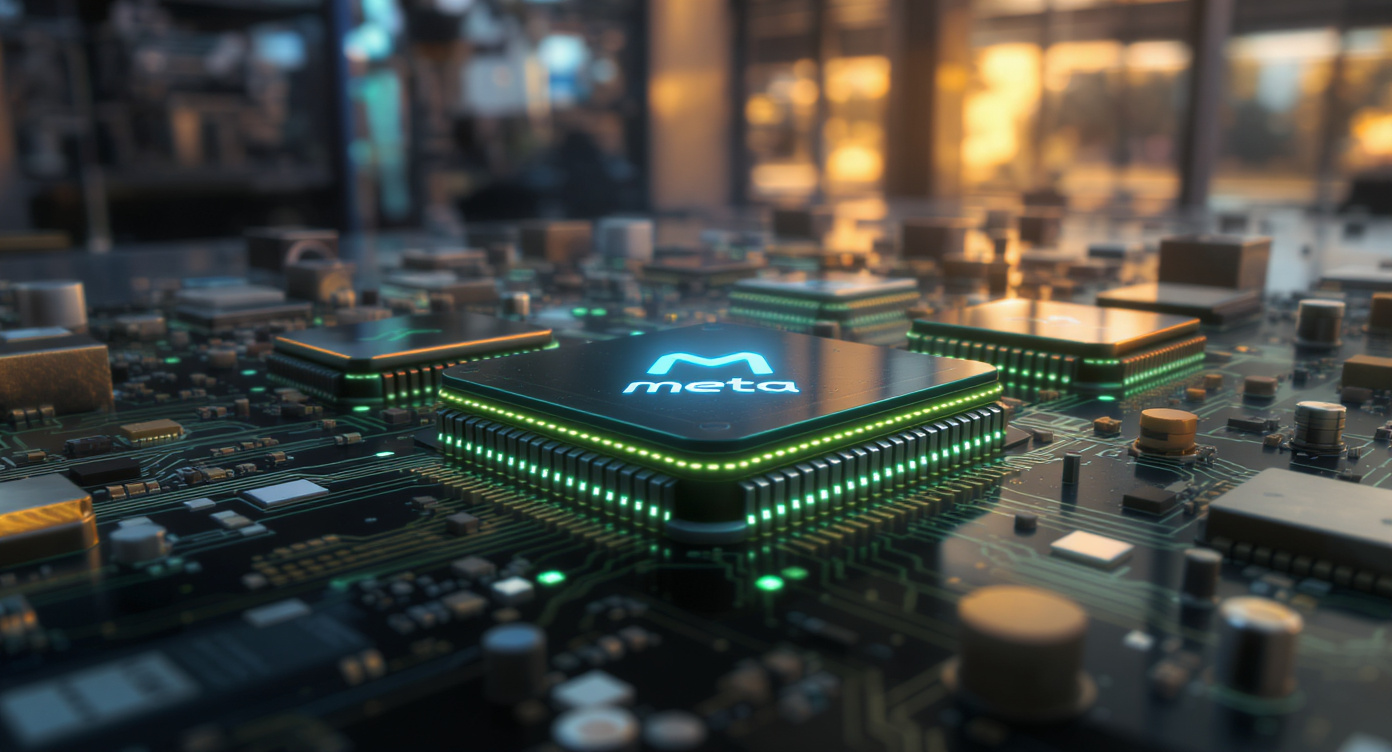
The company’s custom chip strategy encompasses multiple specialized processors, including Training and Inference Accelerator (TIA) chips designed specifically for machine learning workloads. These chips are engineered to handle Meta’s unique AI tasks, from content recommendation algorithms to advanced computer vision applications powering augmented and virtual reality experiences.
Meta’s approach differs significantly from NVIDIA’s general-purpose GPU strategy. While NVIDIA’s chips excel across various AI applications and serve multiple industries, Meta’s custom silicon is laser-focused on optimizing performance for specific workloads within its ecosystem. This specialization allows for architectural innovations that wouldn’t be practical in general-purpose designs.
The company has also invested heavily in building internal expertise, recruiting top talent from established semiconductor companies and partnering with foundries like Taiwan Semiconductor Manufacturing Company (TSMC) for chip production. This comprehensive approach ensures Meta maintains control over both design and manufacturing aspects of its chip strategy.
Technical Advantages and Performance Implications
Meta’s custom AI chips deliver several technical advantages that directly address the company’s operational challenges. First, these chips feature optimized memory hierarchies and data movement patterns specifically designed for Meta’s AI workloads, potentially delivering superior performance per watt compared to general-purpose alternatives.
The architectural optimizations extend to specialized instruction sets and processing units tailored for common operations in Meta’s AI pipelines. For instance, the chips incorporate dedicated hardware for matrix operations, attention mechanisms, and other neural network primitives that form the backbone of modern AI applications.
Energy efficiency represents another crucial advantage. Custom chips can eliminate unnecessary features and optimize power consumption for specific use cases, potentially reducing operational costs significantly given Meta’s massive data center footprint. This efficiency gain becomes particularly important as AI workloads continue to scale exponentially.
Moreover, Meta’s chips can implement novel architectural features that might not be feasible in general-purpose designs due to market constraints. These innovations could include specialized memory controllers, custom interconnect technologies, or unique processing paradigms optimized for specific AI algorithms.
The performance implications extend beyond raw computational power. Custom chips enable Meta to optimize the entire software-hardware stack, from low-level drivers to high-level AI frameworks. This vertical integration approach can eliminate bottlenecks and inefficiencies that arise when using third-party hardware solutions.
Market Impact and NVIDIA’s Response Strategy
Meta’s chip strategy represents a fundamental threat to NVIDIA’s business model, particularly in the data center segment where the company generates the majority of its revenue. As one of NVIDIA’s largest customers, Meta’s transition to custom silicon could significantly impact demand for NVIDIA’s flagship data center GPUs.
The ripple effects extend beyond direct revenue impact. Meta’s success with custom chips could encourage other tech giants to accelerate their own chip development programs, potentially creating a domino effect that fragments NVIDIA’s addressable market. Companies like Google, Amazon, and Microsoft have already made significant investments in custom silicon, but Meta’s aggressive approach could catalyze broader industry adoption.
NVIDIA has responded to this challenge through multiple strategic initiatives. The company continues to push the performance envelope with new architectures like Hopper and the upcoming Blackwell platform, maintaining its technological edge in general-purpose AI acceleration. Additionally, NVIDIA has expanded its software ecosystem through platforms like CUDA and AI Enterprise, creating stronger customer lock-in effects.
The company has also pursued strategic partnerships and acquisitions to strengthen its competitive position. NVIDIA’s acquisition attempts and partnerships with cloud providers demonstrate its recognition of the changing competitive landscape and the need for more comprehensive solutions beyond hardware.
However, NVIDIA’s response strategy faces inherent limitations. The company cannot fully customize its products for individual customers without compromising its business model, which relies on serving diverse markets with standardized products. This constraint creates opportunities for custom silicon providers to capture specific use cases where specialization delivers significant advantages.
Strategic Implications for the AI Industry
Meta’s chip strategy reflects broader structural changes in the AI industry that extend far beyond the immediate competition between Meta and NVIDIA. The trend toward vertical integration and custom silicon development signals a maturation of AI technology, where leading companies seek greater control over their technological destiny.
This shift has profound implications for the semiconductor industry’s value chain. Traditional fabless chip companies may find their market opportunities increasingly constrained as large tech companies develop internal capabilities. Conversely, foundries and manufacturing services providers may benefit from increased demand as more companies pursue custom chip strategies.
The fragmentation of the AI chip market could accelerate innovation by encouraging diverse architectural approaches. While NVIDIA’s dominance has driven significant advances in GPU-based AI acceleration, custom chip development opens possibilities for radically different processing paradigms optimized for specific applications.
From a strategic perspective, Meta’s chip initiative demonstrates the critical importance of semiconductor capabilities in maintaining competitive advantage in AI-driven markets. Companies that fail to develop internal chip expertise or secure reliable access to optimized silicon may find themselves at a significant disadvantage in future AI competitions.
The success or failure of Meta’s chip strategy will likely influence strategic decisions across the tech industry. Positive results could accelerate the trend toward custom silicon, while challenges or setbacks might vindicate NVIDIA’s general-purpose approach and slow the fragmentation of the AI chip market.
The geopolitical dimensions of chip development also play a crucial role in strategic planning. Custom chip development provides greater supply chain control and reduces dependency on external vendors, which has become increasingly important amid growing technological tensions between major economies.
As Meta’s custom AI chip strategy unfolds, it represents more than a simple challenge to NVIDIA’s market position—it embodies a fundamental shift toward specialization and vertical integration in AI infrastructure. The success of this approach could reshape how companies think about AI hardware, potentially ushering in an era where custom silicon becomes the norm rather than the exception for large-scale AI deployments.
What do you think will be the most significant long-term impact of Meta’s custom chip strategy on the broader AI industry—will it accelerate innovation through specialization or fragment the market in ways that ultimately slow progress?


Comments