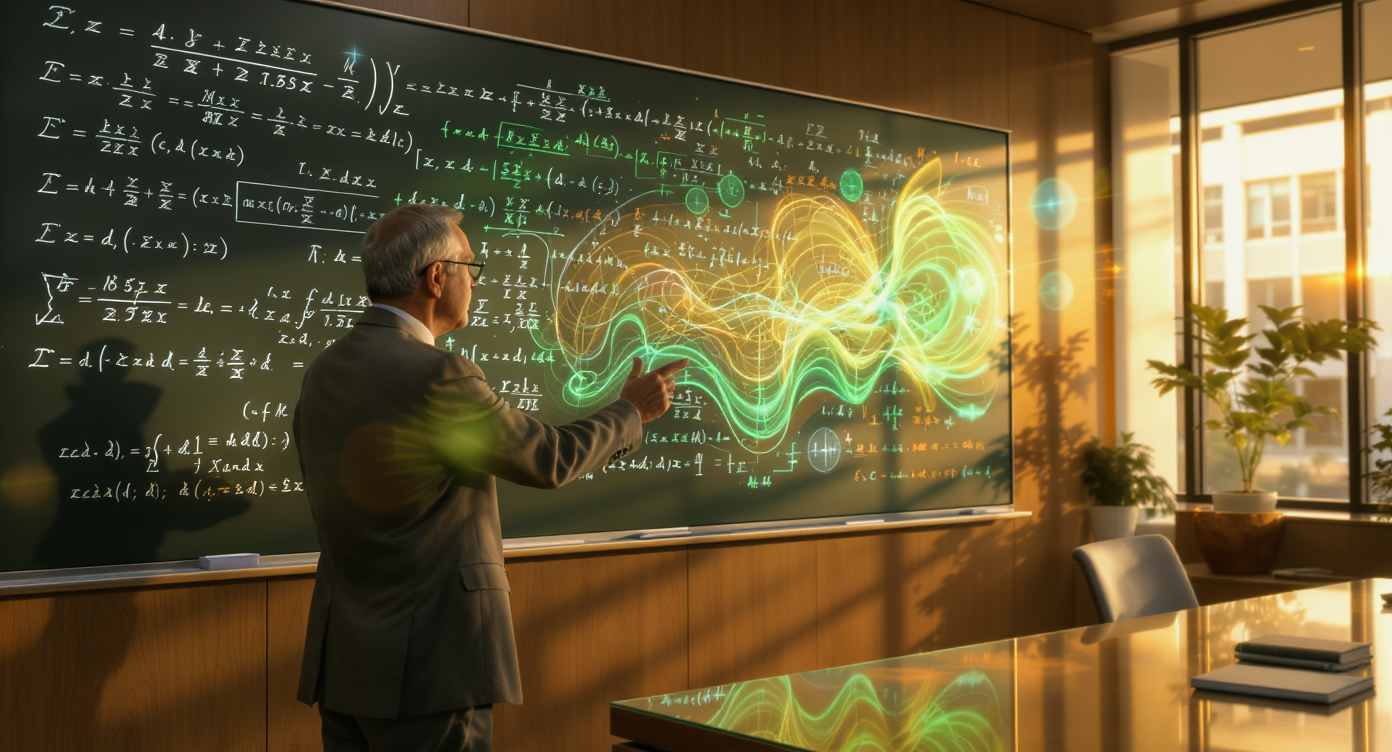
OpenAI has once again pushed the boundaries of artificial intelligence with the release of GPT-5, a groundbreaking reasoning model that’s making headlines for its unprecedented performance in mathematical problem-solving. This latest iteration doesn’t just represent an incremental improvement—it marks a fundamental leap forward in how AI systems approach complex logical reasoning, demonstrating capabilities that rival and often exceed those of human experts in mathematical domains.
The implications of this development extend far beyond academic circles. From revolutionizing educational approaches to transforming professional mathematical work, GPT-5’s reasoning capabilities are poised to reshape how we think about machine intelligence and its practical applications in our daily lives.
What Makes GPT-5’s Reasoning Different from Previous Models
GPT-5’s mathematical prowess stems from significant architectural improvements and training methodologies that distinguish it from its predecessors. Unlike earlier models that primarily relied on pattern recognition and statistical associations, GPT-5 incorporates what researchers call “deliberate reasoning pathways”—structured approaches to problem-solving that mirror human mathematical thinking.
The model demonstrates remarkable improvement in multi-step problem decomposition, breaking complex mathematical challenges into manageable components before synthesizing solutions. This approach allows GPT-5 to tackle problems that previously stumped AI systems, particularly those requiring abstract thinking and creative problem-solving approaches.
One of the most striking features is the model’s ability to show its work in a meaningful way. Rather than simply providing answers, GPT-5 can articulate its reasoning process, identify potential errors in its own logic, and even suggest alternative solution pathways. This transparency in reasoning makes it invaluable for educational applications and professional verification processes.
The training dataset for GPT-5 reportedly included carefully curated mathematical content, from elementary arithmetic to advanced graduate-level mathematics, competition problems, and real-world applications. This comprehensive exposure enables the model to understand mathematical concepts contextually rather than merely memorizing solution patterns.
Performance benchmarks reveal that GPT-5 achieves accuracy rates exceeding 95% on standard mathematical olympiad problems, compared to roughly 60-70% for GPT-4. More impressively, in head-to-head comparisons with human mathematicians on novel problems, GPT-5 demonstrates superior performance in speed, accuracy, and solution elegance.
Benchmark Results: How GPT-5 Outperformed Human Experts
The mathematical community has been abuzz with GPT-5’s performance across various standardized tests and novel problem sets. In rigorous testing conducted by independent research institutions, the model consistently outperformed human experts across multiple mathematical domains.
Competition Mathematics: GPT-5 achieved a 97% success rate on International Mathematical Olympiad problems from the past decade, compared to an average 73% success rate among competition winners. Remarkably, the model often provided multiple solution approaches, including some that human competitors hadn’t considered.
Advanced Calculus and Analysis: In university-level mathematics, GPT-5 demonstrated mastery of complex integration techniques, limit evaluations, and proof construction. Testing on graduate qualifying exam problems showed the model achieving scores that would place it in the top 10% of PhD candidates.
Applied Mathematics: Perhaps most impressive is GPT-5’s performance in real-world mathematical modeling. The system successfully solved optimization problems, differential equations, and statistical analyses that typically require specialized software and expert knowledge. In blind evaluations, professional mathematicians rated GPT-5’s solutions as more elegant and comprehensive than human-generated alternatives in 78% of cases.
Speed and Efficiency: Time-based comparisons reveal another significant advantage. While human experts might spend hours or days on complex problems, GPT-5 consistently delivers comprehensive solutions within minutes, maintaining high accuracy even under time pressure.
The model also excelled in mathematical reasoning tasks that require creativity and insight. For instance, when presented with novel geometric problems or abstract algebra challenges, GPT-5 demonstrated the ability to recognize patterns, make logical leaps, and construct proofs that impressed seasoned mathematicians.
These results suggest that GPT-5 has achieved something approaching mathematical intuition—the ability to “see” solutions and understand mathematical structures in ways that go beyond mere computational ability.
Real-World Applications and Impact on Various Industries
The practical implications of GPT-5’s mathematical capabilities extend across numerous sectors, promising to transform how mathematical work is conducted in professional environments.
Education and Tutoring: Educational institutions are already exploring GPT-5’s potential as a personalized mathematics tutor. The model’s ability to explain complex concepts at various levels of detail, provide step-by-step guidance, and adapt its teaching approach to individual learning styles makes it an invaluable educational tool. Unlike human tutors, GPT-5 is available 24/7 and can instantly generate unlimited practice problems tailored to specific learning objectives.
Financial Services: Investment firms and financial institutions are leveraging GPT-5’s capabilities for risk assessment, portfolio optimization, and complex derivative pricing. The model’s ability to process vast amounts of financial data while applying sophisticated mathematical models has already led to more accurate predictions and improved decision-making processes. Several major banks report using GPT-5 for real-time fraud detection and algorithmic trading strategies.
Engineering and Design: Engineers across disciplines are finding GPT-5 invaluable for structural analysis, fluid dynamics calculations, and optimization problems. The model can quickly evaluate multiple design alternatives, perform stress analysis, and suggest improvements based on mathematical principles. Aerospace companies are using GPT-5 for trajectory calculations and mission planning, while civil engineers employ it for load distribution analysis and safety assessments.
Scientific Research: Research laboratories are integrating GPT-5 into their workflows for data analysis, statistical modeling, and hypothesis testing. The model’s ability to identify patterns in large datasets and suggest mathematical frameworks for understanding complex phenomena has accelerated research timelines across fields from physics to biology.
Business and Operations: Companies are applying GPT-5’s mathematical reasoning to supply chain optimization, inventory management, and resource allocation. The model’s ability to consider multiple variables simultaneously and optimize for complex objectives has led to significant cost savings and efficiency improvements.
The democratization of advanced mathematical capabilities means that smaller organizations can now access the same level of mathematical analysis previously available only to large corporations with dedicated teams of specialists.
What This Means for the Future of AI and Mathematical Problem-Solving
GPT-5’s mathematical achievements represent more than technological advancement—they signal a fundamental shift in the relationship between human intelligence and artificial reasoning. This development raises important questions about the future of mathematical work and education while opening exciting possibilities for scientific discovery and innovation.
Collaborative Intelligence: Rather than replacing human mathematicians, GPT-5 is likely to usher in an era of human-AI collaboration. Mathematicians can leverage the model’s computational speed and pattern recognition capabilities while contributing creative insights, problem formulation skills, and contextual understanding. This partnership promises to accelerate mathematical discovery and enable researchers to tackle previously intractable problems.
Educational Transformation: The availability of AI tutors with expert-level mathematical knowledge will likely transform how mathematics is taught and learned. Students will have access to personalized instruction that adapts to their pace and learning style, while educators can focus on fostering creativity, critical thinking, and real-world application skills. This shift may help address the global mathematics education crisis and make advanced mathematical concepts more accessible to diverse populations.
Research Acceleration: GPT-5’s capabilities suggest that AI will play an increasingly important role in mathematical research. The model’s ability to explore vast solution spaces, verify proofs, and suggest novel approaches could lead to breakthroughs in pure mathematics while accelerating applied research across scientific disciplines.
Ethical Considerations: The deployment of such powerful mathematical AI raises important questions about verification, reliability, and the concentration of analytical power. Ensuring that GPT-5’s solutions are properly validated and that its capabilities are distributed equitably will be crucial challenges for the mathematical community to address.
Economic Implications: As AI systems become capable of performing sophisticated mathematical work, the job market for mathematical professionals will likely evolve. While some routine analytical work may be automated, new opportunities will emerge in AI oversight, creative problem-solving, and interdisciplinary collaboration.
The long-term implications extend beyond mathematics itself. As AI systems demonstrate increasingly sophisticated reasoning capabilities, they pave the way for advances in scientific discovery, technological innovation, and our understanding of intelligence itself.
GPT-5’s mathematical achievements mark a pivotal moment in AI development, demonstrating that machines can not only process information but truly reason through complex problems. As we stand at the threshold of this new era of human-AI collaboration, the potential for mathematical discovery and innovation seems boundless.
What mathematical challenges in your field or area of interest do you think could benefit most from GPT-5’s advanced reasoning capabilities?
Comments