The artificial intelligence revolution has reached a critical bottleneck. As we move through early 2026, the tech industry faces an unprecedented crisis that’s reshaping how companies develop, deploy, and scale their AI systems. The global shortage of specialized AI chips has sent shockwaves through Silicon Valley and beyond, forcing even the most powerful tech giants to reassess their strategies and priorities.
This isn’t just another supply chain hiccup. The current AI chip shortage represents a fundamental mismatch between the explosive demand for artificial intelligence capabilities and the limited production capacity of the sophisticated semiconductors that power these systems. From NVIDIA’s H100 GPUs to Google’s custom TPUs, the specialized processors that enable large language models, computer vision systems, and machine learning workloads have become more precious than gold in today’s market.
The situation has created a domino effect across the entire technology ecosystem. Startups are delaying product launches, established companies are scaling back their AI initiatives, and cloud service providers are implementing strict allocation systems for their AI computing resources. Understanding this crisis and its implications has become essential for anyone involved in technology, from executives making strategic decisions to developers planning their next AI project.
The Perfect Storm: What’s Driving the AI Chip Crisis
The current shortage stems from a convergence of factors that have pushed demand far beyond supply capabilities. The most significant driver is the rapid proliferation of generative AI applications following the mainstream success of ChatGPT and similar platforms. Companies across every industry suddenly found themselves racing to integrate AI capabilities, creating an insatiable appetite for the specialized chips required to train and run these models.
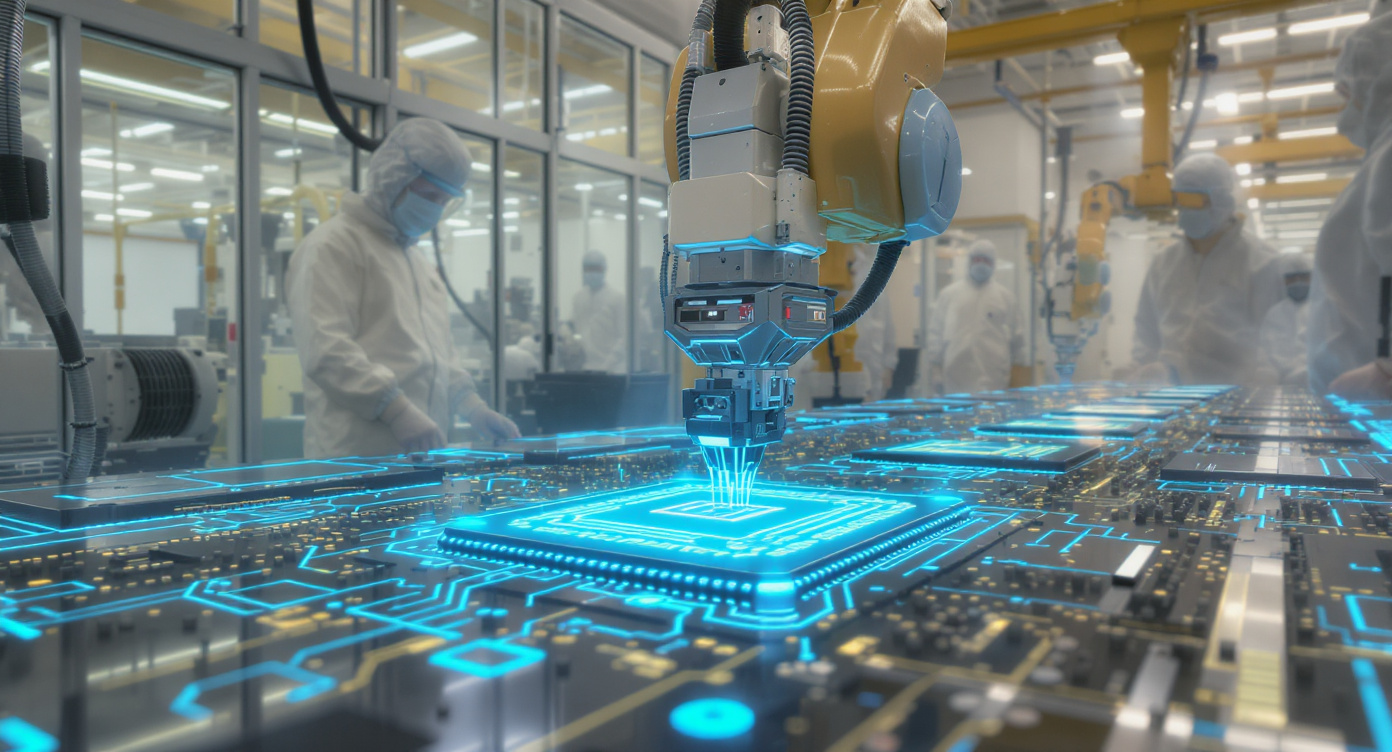
Manufacturing constraints play an equally crucial role. Advanced AI chips require cutting-edge fabrication processes that only a handful of foundries worldwide can execute. Taiwan Semiconductor Manufacturing Company (TSMC) and Samsung dominate this space, but their production capacity was planned years in advance based on pre-2024 demand projections. The exponential growth in AI adoption caught the entire industry off guard.
Geopolitical tensions have exacerbated the situation significantly. Export restrictions and trade controls have limited access to certain chip technologies, while concerns about supply chain security have pushed companies to diversify their sourcing strategies. This fragmentation has reduced efficiency and increased competition for available inventory.
The technical complexity of modern AI workloads has also intensified demand. Training large language models with hundreds of billions of parameters requires massive clusters of high-end GPUs working in parallel for weeks or months. As companies push toward even larger models and more sophisticated AI systems, their chip requirements have grown exponentially rather than linearly.
Tech Giants Scramble: How Industry Leaders Are Adapting
The response from major technology companies has been swift and sometimes desperate. Microsoft, Google, Amazon, and Meta have all acknowledged that chip availability has become their primary constraint for AI development and deployment. These companies are pursuing multiple strategies simultaneously to secure the computing resources they need.
Vertical integration has emerged as a key strategy. Google’s success with its Tensor Processing Units (TPUs) has inspired other companies to develop custom silicon optimized for their specific AI workloads. Amazon’s Trainium and Inferentia chips, Apple’s Neural Engine, and Tesla’s Dojo supercomputer represent significant investments in reducing dependence on third-party chip suppliers.
Cloud providers are implementing sophisticated allocation systems to manage the scarcity. Amazon Web Services, Microsoft Azure, and Google Cloud Platform now operate complex queuing systems for their most powerful AI instances. Customers often wait weeks for access to high-end GPU clusters, and pricing for these resources has increased dramatically.
Strategic partnerships have become increasingly important. Some companies are forming consortiums to share chip inventory and computing resources. Others are entering into long-term supply agreements with chip manufacturers, essentially pre-ordering capacity years in advance. These arrangements provide more predictable access but require significant upfront commitments.
The crisis has also accelerated research into more efficient AI architectures. Companies are investing heavily in model compression techniques, quantization methods, and sparse computing approaches that can deliver similar performance with fewer computational resources. This represents a fundamental shift from the “bigger is better” mentality that dominated AI development in recent years.
The Ripple Effect: Impact Across Industries and Applications
The chip shortage’s effects extend far beyond the major tech companies. Startups and smaller AI companies face particularly acute challenges, as they lack the purchasing power and strategic relationships that help larger firms secure chip allocations. Many promising AI ventures have been forced to delay launches, reduce their ambitions, or pivot to less resource-intensive approaches.
Enterprise AI adoption has slowed significantly across multiple sectors. Companies that planned to implement sophisticated AI systems for manufacturing optimization, financial analysis, or customer service are finding that the required computing infrastructure is either unavailable or prohibitively expensive. This has created a two-tier system where only the largest corporations can afford to pursue cutting-edge AI initiatives.
The automotive industry faces unique challenges as the chip shortage intersects with the race toward autonomous vehicles. Self-driving car development requires enormous amounts of training data processing and real-time inference capabilities. Companies like Waymo, Cruise, and Tesla are competing not just for talent and market share, but for the computational resources necessary to advance their technology.
Healthcare AI applications have also been significantly impacted. Medical imaging analysis, drug discovery platforms, and diagnostic systems all rely on intensive computational processing. The shortage has slowed the development of potentially life-saving technologies and increased costs for healthcare providers looking to implement AI solutions.
Research institutions and universities represent another casualty of the crisis. Academic AI research has traditionally relied on relatively modest computing resources, but modern deep learning research increasingly requires access to large-scale clusters. Many research projects have been scaled back or abandoned entirely due to insufficient computational access.
Strategic Solutions: Navigating the Shortage
Organizations across the spectrum are developing creative strategies to maintain their AI initiatives despite chip constraints. Optimization and efficiency have become primary focuses, with teams working to maximize the performance of existing hardware through better software design and resource management.
Hybrid and multi-cloud strategies are gaining popularity as companies spread their workloads across multiple providers to access whatever capacity is available. This approach requires more complex orchestration but provides better flexibility in a constrained market. Companies are also exploring edge computing solutions that distribute AI processing across many smaller devices rather than concentrating it in centralized data centers.
Collaborative approaches are emerging as viable alternatives to going it alone. Industry consortiums, research collaboratives, and shared computing initiatives allow organizations to pool resources and share access to scarce infrastructure. These partnerships require careful coordination but can provide access to capabilities that would be impossible to achieve independently.
Time-sharing and scheduling optimization have become sophisticated disciplines within AI operations teams. Companies are implementing advanced queuing systems that maximize utilization of available hardware by carefully orchestrating when different training jobs and inference workloads run. This requires new tools and expertise but can significantly improve efficiency.
The crisis has also sparked innovation in AI software and algorithms. Techniques like federated learning, which distributes training across multiple devices, and progressive training methods that gradually increase model complexity are helping teams achieve better results with limited hardware resources. These approaches often provide additional benefits like improved privacy and reduced energy consumption.
The Road Ahead: Long-Term Implications and Opportunities
While the current shortage presents significant challenges, it’s also driving innovation and strategic thinking that will benefit the industry long-term. The crisis has highlighted the importance of sustainable AI development practices and the need for more efficient approaches to machine learning. Companies that learn to do more with less during this period will maintain competitive advantages even when chip availability improves.
The geopolitical dimensions of the shortage are prompting significant investments in domestic chip manufacturing capabilities. The United States, European Union, and other regions are implementing policies and funding programs designed to reduce dependence on concentrated supply chains. These initiatives will take years to materialize but promise to create a more resilient and distributed manufacturing ecosystem.
New technologies emerging from the constraint could reshape the AI landscape permanently. Neuromorphic computing, quantum-classical hybrid systems, and novel semiconductor materials are all receiving increased attention as potential solutions to current limitations. While still in early stages, these technologies could provide breakthrough capabilities that make current chip architectures obsolete.
The shortage is also forcing a more thoughtful approach to AI deployment. Rather than applying massive models to every problem, organizations are becoming more strategic about where and how they use their limited computational resources. This trend toward purposeful and efficient AI implementation represents a maturation of the field that was probably overdue.
As we navigate this unprecedented AI chip shortage, the technology industry finds itself at a crucial inflection point. The companies and strategies that emerge successfully from this crisis will likely define the next phase of artificial intelligence development. The shortage is painful, but it’s also catalyzing innovations in efficiency, collaboration, and strategic thinking that will benefit the entire ecosystem.
How is your organization adapting to the AI chip shortage, and what innovative strategies have you discovered for maximizing the impact of limited computational resources?


Comments