
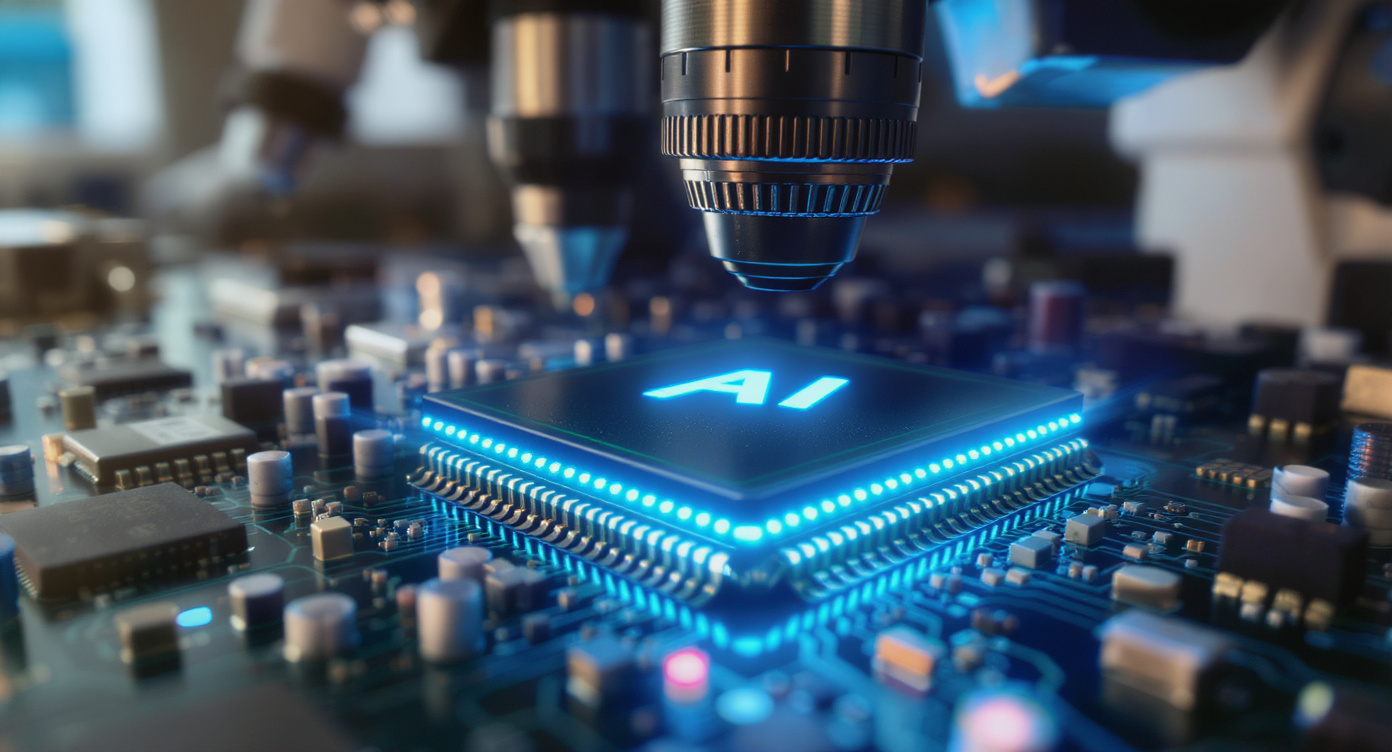
The semiconductor industry has reached another historic milestone with the successful development of 2-nanometer (2nm) AI chips, marking a quantum leap in processing power that promises to reshape everything from smartphones to supercomputers. This breakthrough represents more than just a smaller transistor size—it’s the gateway to unprecedented computational capabilities that will accelerate artificial intelligence applications across every sector of our digital economy.
Leading chip manufacturers, including Taiwan Semiconductor Manufacturing Company (TSMC) and Samsung, have invested billions of dollars and years of research to crack the code on 2nm technology. Early production samples demonstrate processing speeds up to 20% faster than current 3nm chips while consuming 30% less power, setting the stage for a new era of energy-efficient, high-performance computing.
The implications extend far beyond technical specifications. As AI workloads become increasingly complex and power-hungry, these advanced chips arrive at a critical juncture when the industry desperately needs more efficient solutions. From training large language models to enabling real-time edge computing in autonomous vehicles, 2nm AI chips represent the hardware foundation upon which the next generation of intelligent applications will be built.
The Science Behind 2nm Technology Breakthroughs
Understanding the significance of 2nm chips requires grasping the engineering marvel behind shrinking transistors to atomic scales. At 2 nanometers, we’re working with dimensions roughly 20 times smaller than the width of human DNA, where individual silicon atoms become critical factors in chip design and manufacturing.
The transition from 3nm to 2nm technology involves revolutionary changes in manufacturing processes. Traditional silicon-based fabrication methods reach their physical limits at these scales, forcing manufacturers to adopt new materials and techniques. Gate-all-around (GAA) transistor architectures replace traditional FinFET designs, providing better control over electrical current and reducing power leakage that becomes problematic at smaller scales.
Manufacturing 2nm chips requires extreme ultraviolet (EUV) lithography systems that cost over $200 million each and use light wavelengths shorter than X-rays to etch circuit patterns onto silicon wafers. The precision demanded is staggering—maintaining accuracy within a few atoms while creating billions of transistors on a chip smaller than a fingernail.
Perhaps most importantly for AI applications, 2nm technology enables specialized neural processing units (NPUs) and tensor processing units (TPUs) to be integrated more densely than ever before. This means AI chips can pack more computational cores dedicated to machine learning tasks, dramatically improving performance for training neural networks and running inference workloads.
The power efficiency gains are equally impressive. By reducing the voltage required to switch transistors and minimizing electrical resistance, 2nm chips can perform the same calculations as their predecessors while drawing significantly less power. This breakthrough is crucial for mobile AI applications and large-scale data centers where energy consumption directly impacts operational costs and environmental sustainability.
Industries Set for Transformation
The ripple effects of 2nm AI chips will be felt across virtually every technology-dependent industry, with some sectors positioned for particularly dramatic transformations. Mobile computing stands to benefit immediately, as smartphones and tablets equipped with 2nm processors will deliver desktop-class AI performance while maintaining all-day battery life.
In the automotive industry, 2nm AI chips will accelerate the deployment of fully autonomous vehicles by enabling real-time processing of massive amounts of sensor data. Current self-driving car prototypes require substantial computing hardware that consumes significant power and generates considerable heat. With 2nm technology, these systems can be miniaturized and made more efficient, bringing autonomous driving closer to mainstream adoption.
Healthcare applications represent another frontier where 2nm AI chips will drive innovation. Medical imaging devices powered by these advanced processors will provide faster, more accurate diagnoses by running sophisticated AI models locally rather than relying on cloud connectivity. Wearable health monitors will gain the ability to perform complex analysis of biometric data in real-time, potentially detecting health issues before symptoms appear.
The data center industry faces massive transformation as well. Training state-of-the-art AI models currently requires enormous server farms consuming megawatts of electricity. With 2nm AI chips, the same computational workloads can be completed using fewer servers and less energy, making advanced AI development more accessible to smaller organizations and reducing the environmental impact of machine learning research.
Edge computing applications will flourish as 2nm chips make it possible to deploy sophisticated AI models in previously impossible locations. Smart city infrastructure, industrial IoT sensors, and remote monitoring systems will gain unprecedented analytical capabilities without requiring constant internet connectivity or cloud processing power.
Gaming and entertainment industries will leverage 2nm AI chips to create more immersive experiences through real-time ray tracing, procedural content generation, and adaptive gameplay that responds intelligently to player behavior. Virtual and augmented reality applications will benefit from the combination of increased processing power and improved power efficiency, enabling lighter, more comfortable headsets with longer battery life.
Overcoming Manufacturing and Implementation Challenges
Despite the promising capabilities of 2nm technology, significant hurdles remain before these chips reach widespread adoption. Manufacturing complexity represents the most immediate challenge, as producing 2nm chips requires unprecedented precision and quality control throughout the fabrication process.
Yield rates—the percentage of functional chips produced from each silicon wafer—initially suffer when transitioning to new manufacturing processes. Early 2nm production runs may see yield rates below 50%, meaning more than half of the chips produced fail quality testing. As manufacturers refine their processes and identify common failure points, yield rates will improve, but this optimization process typically takes 12-18 months.
Cost considerations present another significant barrier. The expensive equipment required for 2nm manufacturing means these chips will initially command premium prices, limiting their use to high-end applications where the performance benefits justify the additional cost. Only as production scales up and manufacturing processes mature will 2nm chips become economically viable for mainstream consumer products.
Heat dissipation remains a persistent challenge despite improved power efficiency. While 2nm chips consume less power per transistor, the increased transistor density can create localized hot spots that affect performance and reliability. Advanced cooling solutions and intelligent thermal management systems will be essential for maximizing the potential of 2nm AI chips.
Software optimization represents an often-overlooked challenge in adopting new chip architectures. AI frameworks, operating systems, and applications must be updated to take full advantage of 2nm chip capabilities. This software evolution process can take years, potentially delaying the realization of the full benefits these new processors offer.
Supply chain complexity adds another layer of difficulty. The specialized materials, equipment, and expertise required for 2nm manufacturing create dependencies on a limited number of suppliers worldwide. Geopolitical tensions and trade restrictions could impact the availability and cost of 2nm chips, affecting global technology development.
Quality assurance becomes exponentially more challenging at 2nm scales, where individual atomic defects can render entire chips non-functional. New testing methodologies and quality control processes must be developed to ensure reliability while maintaining reasonable production timelines.
Market Timeline and Future Outlook
Industry analysts project that 2nm AI chips will begin appearing in premium consumer devices by late 2025, with broader market adoption following throughout 2026 and 2027. The rollout will likely follow historical patterns, starting with flagship smartphones and high-end graphics cards before expanding to laptops, tablets, and eventually mainstream consumer electronics.
Enterprise and data center applications may see earlier adoption, as organizations requiring cutting-edge AI performance are often willing to pay premium prices for competitive advantages. Cloud computing providers like Amazon Web Services, Google Cloud, and Microsoft Azure are likely to be among the first to deploy 2nm AI chips at scale, offering enhanced machine learning services to their customers.
The automotive industry’s adoption timeline depends heavily on regulatory approvals and safety testing requirements. While 2nm chips may appear in prototype autonomous vehicles by 2025, widespread deployment in production vehicles will likely occur in the 2027-2029 timeframe as manufacturers complete extensive validation processes.
Looking beyond 2nm, semiconductor manufacturers are already researching 1.4nm and even 1nm technologies, though each successive generation faces increasingly difficult physics and engineering challenges. Some experts predict that Moore’s Law—the observation that transistor density doubles approximately every two years—may finally reach its practical limits within the next decade.
Alternative approaches to traditional silicon-based computing are gaining attention as potential successors to current chip architectures. Quantum computing, neuromorphic chips that mimic brain structures, and optical computing all represent possible pathways for continued advancement in computational capability.
The geopolitical landscape will significantly influence the development and distribution of 2nm technology. As governments recognize advanced semiconductors as critical national infrastructure, we can expect increased investment in domestic chip manufacturing capabilities and potential restrictions on technology transfers between countries.
Environmental considerations are becoming increasingly important in semiconductor development. The energy-intensive manufacturing processes for 2nm chips must be balanced against their improved power efficiency in use. Lifecycle assessments will help determine whether the environmental costs of production are justified by reduced energy consumption during operation.
The advent of 2nm AI chips marks a pivotal moment in computing history, promising to unlock new possibilities in artificial intelligence while presenting significant challenges for manufacturers and implementers alike. As we stand on the brink of this processing revolution, the question becomes not whether these advanced chips will transform our digital landscape, but how quickly industries can adapt to harness their unprecedented capabilities.
What aspects of the 2nm AI chip revolution do you think will have the most immediate impact on your industry or daily life?

Comments