
The Revolutionary Impact of AI on Urban Energy Management
Cities consume over 70% of global energy while producing 80% of greenhouse gas emissions. As urban populations surge toward 5 billion by 2030, the pressure to create sustainable, efficient metropolitan areas has never been greater. Enter artificial intelligence – the game-changing technology that’s transforming how cities manage energy consumption.
In 2026, AI-powered smart cities are achieving remarkable 40% reductions in energy costs, setting new benchmarks for urban sustainability and operational efficiency. This isn’t just about cutting expenses; it’s about reimagining how cities function, breathe, and serve their residents while protecting our planet’s future.
The convergence of machine learning algorithms, Internet of Things (IoT) sensors, and advanced data analytics has created an unprecedented opportunity for cities to optimize their energy infrastructure. From Barcelona’s smart lighting systems to Singapore’s predictive cooling networks, municipalities worldwide are harnessing AI to create more responsive, efficient urban environments.
These technological advances represent more than incremental improvements – they signal a fundamental shift toward intelligent urban ecosystems that learn, adapt, and optimize themselves in real-time. The results speak volumes: reduced carbon footprints, lower operational costs, and improved quality of life for millions of urban dwellers.
Key Technologies Driving Smart City Energy Efficiency
Machine Learning-Powered Grid Optimization
Advanced machine learning algorithms analyze vast datasets from smart meters, weather stations, and usage patterns to predict energy demand with remarkable accuracy. These systems identify consumption trends, detect anomalies, and automatically adjust power distribution to minimize waste and peak-load stress.
Predictive maintenance has emerged as a cornerstone technology, using AI to monitor infrastructure health and predict equipment failures before they occur. This proactive approach reduces energy waste from inefficient systems while extending equipment lifespan and reducing replacement costs.
Intelligent Building Management Systems
Smart buildings equipped with AI-driven HVAC systems automatically adjust temperature, lighting, and ventilation based on occupancy patterns, weather conditions, and energy prices. These systems learn from historical data and user preferences to create optimal comfort conditions while minimizing energy consumption.
Dynamic lighting networks represent another breakthrough, with LED streetlights that dim or brighten based on pedestrian traffic, weather conditions, and safety requirements. Cities like Los Angeles have reported 60% reductions in street lighting energy consumption through these intelligent systems.
Integrated Transportation Networks
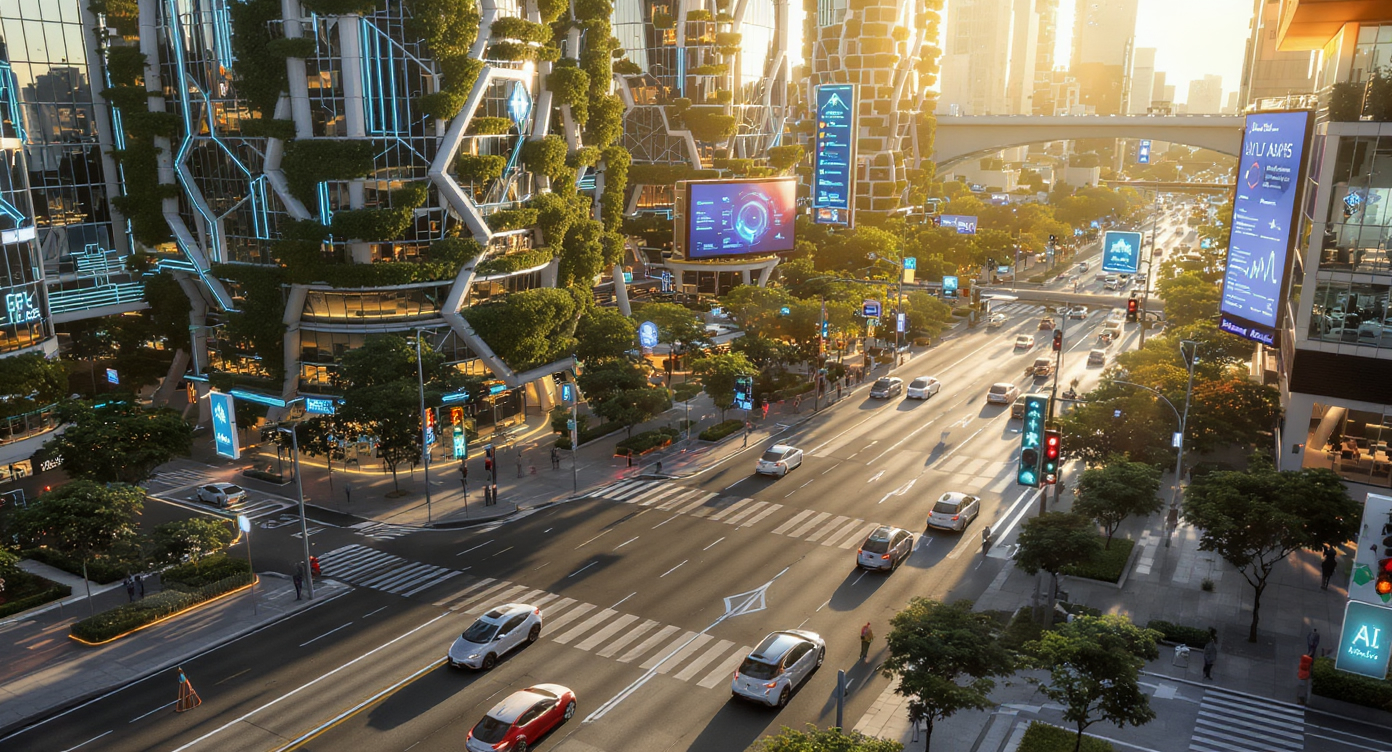
AI-optimized traffic management systems reduce vehicle idle time and improve traffic flow, significantly decreasing transportation-related energy consumption. Smart traffic signals adapt to real-time conditions, while electric vehicle charging stations optimize their operations based on grid demand and renewable energy availability.
Autonomous public transit systems further enhance efficiency by optimizing routes, reducing empty vehicle miles, and coordinating with other transportation modes to create seamless, energy-efficient mobility networks.
Real-World Implementation Success Stories
Barcelona’s Holistic Smart City Approach
Barcelona has emerged as a global leader in smart city implementation, integrating AI across multiple urban systems. The city’s smart lighting network adjusts brightness based on pedestrian activity, while intelligent parking systems guide drivers to available spaces, reducing traffic congestion and emissions.
The city’s smart water management system uses AI to detect leaks, optimize distribution pressure, and predict maintenance needs, resulting in 25% water savings and significant energy reductions in pumping and treatment facilities.
Singapore’s Urban Sensing Platform
Singapore’s comprehensive IoT sensor network collects real-time data on air quality, temperature, humidity, and energy usage across the city-state. AI algorithms process this information to optimize building cooling systems, predict energy demand, and coordinate renewable energy integration.
The city’s district cooling optimization program uses machine learning to predict cooling loads and adjust central plant operations, achieving 30% energy savings compared to traditional systems.
Amsterdam’s Circular Economy Integration
Amsterdam has pioneered the integration of AI with circular economy principles, using machine learning to optimize waste-to-energy systems and coordinate renewable energy sources. The city’s smart grid platform balances supply and demand in real-time, maximizing the use of solar and wind power while maintaining grid stability.
Energy storage optimization plays a crucial role, with AI systems determining optimal charging and discharging schedules for battery systems based on energy prices, weather forecasts, and grid conditions.
Copenhagen’s Carbon Neutral Vision
Copenhagen’s ambitious carbon neutrality goals are supported by an extensive AI-powered energy management system. The city uses machine learning to optimize district heating networks, coordinate electric vehicle charging, and integrate renewable energy sources.
Predictive analytics help the city anticipate energy demand fluctuations and adjust generation accordingly, reducing waste and improving grid stability while supporting the integration of variable renewable energy sources.
Overcoming Implementation Challenges and Future Opportunities
Technical Infrastructure Requirements
Implementing AI-powered energy management requires substantial technological infrastructure, including high-speed communication networks, cloud computing capabilities, and extensive sensor deployments. Cities must invest in 5G networks and edge computing systems to support real-time data processing and decision-making.
Data standardization presents another significant challenge, as cities must integrate information from diverse sources and legacy systems. Successful implementation requires comprehensive data governance frameworks and interoperability standards.
Privacy and Security Considerations
Smart city systems collect vast amounts of data about citizen behavior and energy usage patterns, raising important privacy concerns. Cities must implement robust cybersecurity measures and transparent data governance policies to maintain public trust while protecting sensitive information.
Blockchain technology is emerging as a solution for secure, decentralized energy transactions and data sharing, enabling peer-to-peer energy trading and transparent consumption tracking.
Financial and Organizational Barriers
The initial investment required for smart city infrastructure can be substantial, requiring innovative financing mechanisms and public-private partnerships. Cities must develop comprehensive business cases that account for long-term energy savings, environmental benefits, and improved quality of life.
Change management within city organizations is equally important, as staff must adapt to new technologies and data-driven decision-making processes. Successful implementation requires extensive training programs and organizational culture shifts.
Scalability and Future Integration
As AI technologies continue to evolve, cities must design flexible systems that can accommodate future innovations and expanding capabilities. Modular architectures allow for gradual implementation and continuous improvement while avoiding technology lock-in.
Interoperability standards become increasingly important as cities seek to integrate new technologies and share best practices with other municipalities worldwide.
Building Tomorrow’s Sustainable Urban Future
The 40% energy cost reductions achieved by AI-powered smart cities in 2026 represent just the beginning of a transformation that will reshape urban life for generations. These early successes demonstrate the tremendous potential of artificial intelligence to create more sustainable, efficient, and livable cities.
Machine learning algorithms will become increasingly sophisticated, enabling cities to optimize energy systems with greater precision and predictive capability. The integration of quantum computing and advanced AI models promises even more dramatic improvements in the coming decade.
Citizen engagement will play an increasingly important role, with AI-powered platforms providing residents with personalized energy insights and recommendations. Gamification and social comparison features encourage conservation behavior while building community awareness around sustainability goals.
The path forward requires continued collaboration between technology providers, city governments, and citizens to ensure that smart city implementations serve the needs of all urban residents while advancing global sustainability objectives.
Cities that embrace AI-powered energy management today position themselves as leaders in the global transition toward sustainable urban development. The technologies and approaches pioneered in these early implementations will serve as blueprints for cities worldwide as they work to address climate change and urban growth challenges.
The transformation of urban energy systems through artificial intelligence represents one of the most significant opportunities to address climate change while improving quality of life for billions of people. As we move beyond 2026, the question isn’t whether cities will adopt these technologies, but how quickly they can implement them at scale.
What specific AI-powered energy solutions do you think would have the greatest impact in your city, and what barriers might prevent their implementation?

Comments