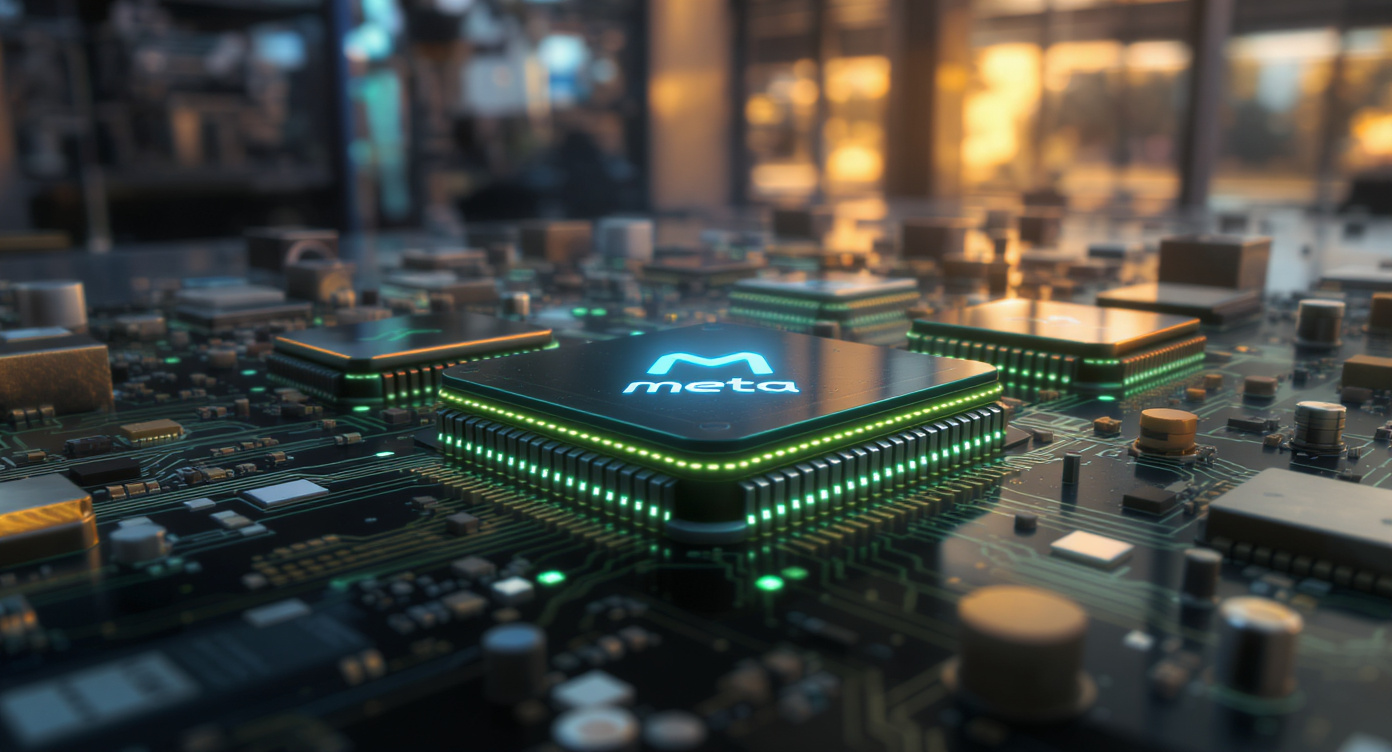
The artificial intelligence landscape is experiencing a seismic shift as Meta, the tech giant behind Facebook, Instagram, and WhatsApp, unveils its ambitious foray into custom AI chip development. This strategic move represents more than just another tech company diversifying its hardware portfolio—it’s a direct challenge to NVIDIA’s seemingly unshakeable dominance in the AI semiconductor market.
For years, NVIDIA has reigned supreme in the AI chip ecosystem, with their Graphics Processing Units (GPUs) becoming the gold standard for machine learning workloads. However, Meta’s entry into this space signals a new era of competition that could reshape how AI infrastructure is built, deployed, and scaled across the industry.
The significance of this development extends far beyond corporate rivalry. As AI continues to permeate every aspect of digital life, from social media algorithms to autonomous vehicles, the companies controlling the underlying hardware hold tremendous influence over the pace and direction of technological advancement. Meta’s challenge to NVIDIA represents a pivotal moment that could democratize AI development and drive innovation in ways we’re only beginning to understand.
The Genesis of Meta’s AI Chip Strategy
Meta’s journey into custom silicon didn’t happen overnight. The company’s massive scale of operations—serving billions of users across multiple platforms—has created unique computational challenges that off-the-shelf solutions struggle to address efficiently. With data centers consuming enormous amounts of energy and requiring increasingly sophisticated AI capabilities, Meta recognized that controlling their hardware destiny was not just advantageous but essential.
The company’s AI chip initiative centers around their Meta Training and Inference Accelerator (MTIA) chips, specifically designed to handle the company’s AI workloads more efficiently than traditional GPUs. Unlike NVIDIA’s general-purpose approach, Meta’s chips are optimized for their specific use cases, including content recommendation algorithms, computer vision tasks, and natural language processing applications that power their social media platforms.
This strategic pivot reflects a broader industry trend toward vertical integration. Just as Apple revolutionized mobile computing by designing their own processors, Meta aims to achieve similar breakthroughs by tailoring hardware to their exact specifications. The potential benefits are substantial: improved performance, reduced costs, enhanced energy efficiency, and greater control over their technological roadmap.
Meta’s investment in custom silicon also represents a hedge against supply chain vulnerabilities and vendor dependencies that have plagued the tech industry in recent years. By developing in-house capabilities, the company reduces its reliance on external suppliers and gains greater flexibility in responding to changing market conditions and technological requirements.
NVIDIA’s Market Position: Strengths and Vulnerabilities
To understand the significance of Meta’s challenge, it’s crucial to examine NVIDIA’s current market position. The company has built an impressive moat around their AI chip business, leveraging several key advantages that have made them the preferred choice for AI researchers, startups, and enterprise customers worldwide.
NVIDIA’s core strengths include:
- CUDA Ecosystem: Their proprietary parallel computing platform has become the de facto standard for AI development, creating significant switching costs for developers
- Software Integration: Comprehensive development tools and libraries that streamline AI application development
- Performance Leadership: Consistent delivery of cutting-edge performance improvements with each new generation of chips
- Market Maturity: Established relationships with cloud providers, research institutions, and enterprise customers
However, NVIDIA’s dominance also reveals potential vulnerabilities that Meta and other competitors can exploit. The company’s success has led to premium pricing, which creates opportunities for more cost-effective alternatives. Additionally, NVIDIA’s general-purpose approach, while versatile, may not be optimal for specific use cases where specialized chips could deliver superior performance or efficiency.
The growing demand for AI compute has also strained NVIDIA’s supply chains, leading to availability issues and long lead times that frustrate customers. This supply constraint has created an opening for alternative solutions, particularly for companies with specific, high-volume requirements like Meta.
Perhaps most importantly, NVIDIA’s success has attracted regulatory attention and raised concerns about market concentration in critical AI infrastructure. This scrutiny could limit their ability to maintain pricing power or pursue certain strategic initiatives, creating additional opportunities for competitors.
Technical Innovation and Performance Comparisons
Meta’s MTIA chips represent a fundamentally different approach to AI acceleration compared to NVIDIA’s GPU architecture. While NVIDIA’s chips excel at parallel processing across a wide range of applications, Meta’s design prioritizes specific AI workloads that dominate their operational requirements.
Key technical differentiators of Meta’s approach include:
Specialized Architecture: MTIA chips are optimized for inference workloads rather than training, reflecting Meta’s primary use case of serving AI models to billions of users in real-time. This specialization allows for more efficient silicon utilization and reduced power consumption.
Memory Optimization: The chips feature custom memory hierarchies designed to minimize data movement, a critical factor in AI performance and energy efficiency. This approach addresses one of the primary bottlenecks in traditional GPU-based systems.
Interconnect Technology: Meta has developed proprietary networking solutions that enable efficient scaling across multiple chips and servers, essential for handling their massive computational requirements.
Software Integration: Unlike NVIDIA’s CUDA ecosystem, Meta is developing open-source software tools that could encourage broader adoption of their hardware architecture.
Early performance benchmarks suggest that Meta’s chips deliver significant improvements in energy efficiency for specific workloads, with some reports indicating 20-30% better performance per watt compared to equivalent NVIDIA solutions. However, these gains come with trade-offs in versatility and general-purpose computing capabilities.
The real test of Meta’s technical innovation will be in real-world deployment at scale. While laboratory benchmarks are promising, the complexity of production AI systems introduces variables that can significantly impact actual performance and reliability.
Market Implications and Industry Impact
Meta’s entry into the AI chip market carries profound implications that extend well beyond the company’s own operations. The move could catalyze a broader shift in how the industry approaches AI infrastructure, potentially leading to increased competition, innovation, and specialization.
Immediate market effects include:
Pricing Pressure: Meta’s alternative could force NVIDIA to reconsider their pricing strategies, particularly for high-volume customers with specific use cases similar to Meta’s requirements.
Innovation Acceleration: Competition typically drives faster innovation cycles. NVIDIA may need to accelerate their development timelines and explore new architectural approaches to maintain their competitive edge.
Customer Empowerment: Large tech companies now have a proven alternative to NVIDIA’s solutions, strengthening their negotiating position and providing leverage in supplier relationships.
The long-term implications could be even more significant. If Meta’s approach proves successful, it could inspire other major tech companies to develop their own specialized AI chips. Google has already made significant strides with their TPU (Tensor Processing Unit) technology, and companies like Amazon, Microsoft, and Apple are all investing heavily in custom silicon.
This trend toward specialization could lead to a more fragmented but potentially more innovative AI hardware landscape. Rather than a single dominant player, we might see an ecosystem of specialized solutions optimized for different use cases, from edge computing to large-scale data center deployment.
The democratization effect could also be substantial. As more companies develop AI chips and open-source the supporting software tools, smaller organizations and researchers might gain access to high-performance AI computing that was previously dominated by NVIDIA’s ecosystem.
However, this fragmentation also presents challenges. Developers may need to work with multiple hardware platforms and software stacks, potentially increasing complexity and development costs. The industry will need to balance the benefits of specialization with the advantages of standardization.
Meta’s chip strategy also highlights the growing importance of AI sovereignty—the ability of companies and nations to control their own AI infrastructure. As AI becomes increasingly critical to economic competitiveness and national security, the companies and countries that control the underlying hardware will wield significant influence.
The semiconductor industry’s geopolitical dimensions add another layer of complexity to this competition. Trade restrictions, export controls, and national security considerations are increasingly influencing chip development and distribution, making domestic or allied capabilities more valuable than ever.
Meta’s challenge to NVIDIA represents more than just corporate competition—it’s a fundamental shift in how we think about AI infrastructure and the future of technological innovation. While NVIDIA’s established ecosystem and technical expertise provide significant advantages, Meta’s specialized approach and massive scale create a compelling alternative that could reshape the industry.
The ultimate winners in this competition will likely be AI developers and users who benefit from increased choice, improved performance, and more competitive pricing. As this battle unfolds, we’re witnessing the emergence of a more diverse and dynamic AI hardware ecosystem that could accelerate innovation across the entire industry.
What do you think will be the most significant impact of Meta’s AI chip challenge on the broader technology industry, and how might it change the way companies approach AI infrastructure decisions?



Comments