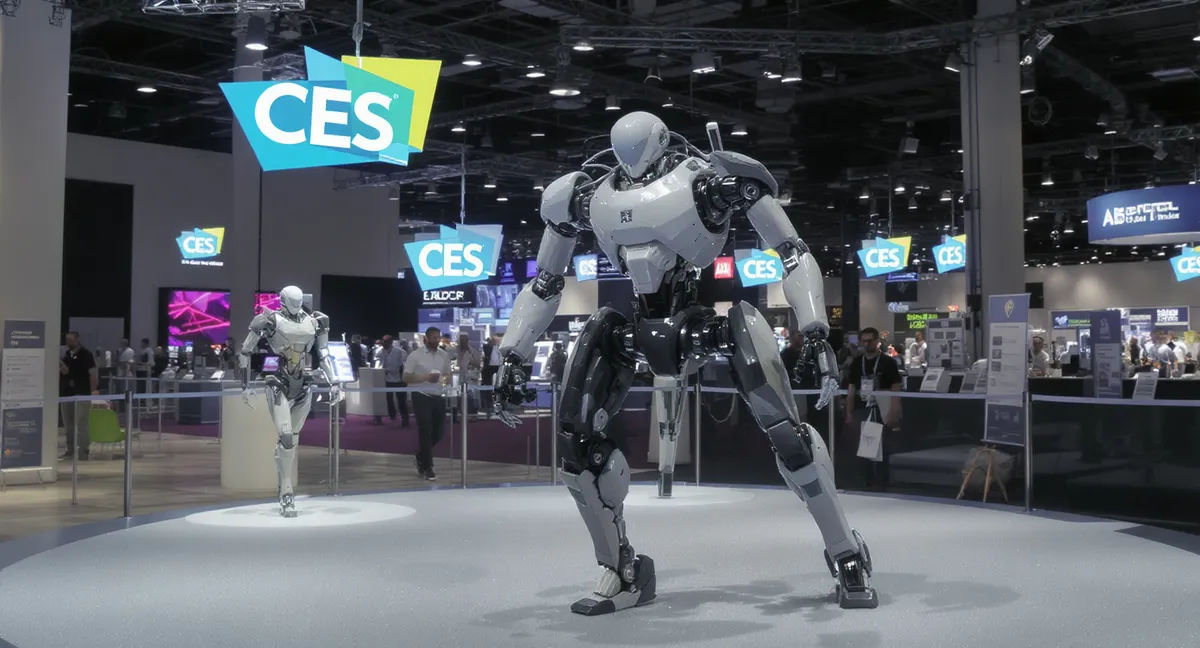
CES 2026 made one thing clear: humanoid robots are no longer science fiction demos—they’re products preparing for deployment. From a robot completing a half-marathon to Boston Dynamics announcing factory deployments, the show marked a turning point for bipedal AI.
The Half-Marathon Robot
X-Humanoid’s Embodied Tien Kung Ultra stole headlines by becoming the world’s first humanoid robot to complete a half-marathon (21.0975 km) fully autonomously. The run took 2 hours and 40 minutes—not world-record pace, but remarkable for a machine navigating real-world terrain without human control.
The same robot also ran 100 meters autonomously in 21.50 seconds, demonstrating the improving speed and stability of humanoid locomotion.
Boston Dynamics Goes Electric
Boston Dynamics confirmed its fully electric Atlas humanoid will deploy at Hyundai’s Georgia electric vehicle plant by 2028. This represents a major milestone: one of the most sophisticated humanoid robots moving from demonstration to actual manufacturing work.
The electric Atlas trades the hydraulics of earlier models for cleaner, quieter electric actuators—essential for working alongside humans in factory environments. The target: complex assembly roles that current automation struggles to handle.
Why Humanoid Form?
Why build robots shaped like humans when wheels and arms work fine? Several reasons are becoming clearer:
Human-Designed Environments
Our world is built for human bodies. Stairs, doors, tools, and workspaces assume humanoid proportions. Robots that share our form factor can navigate these spaces without modifications.
Versatility
Specialized robots excel at specific tasks but fail outside their design parameters. Humanoid robots can potentially handle the full range of tasks humans perform, making them more versatile investments.
Human Collaboration
Working alongside people is easier when you move similarly. Humanoid motion is intuitive for human coworkers to predict and accommodate.
Existing Tools
Billions of tools are designed for human hands. Humanoid robots can potentially use existing equipment rather than requiring specialized robotic versions.
Key Technologies
Several advances are making practical humanoids possible:
Balance and Locomotion
AI systems now maintain balance across uneven terrain, stairs, and unexpected obstacles. This seemed impossible a decade ago but is now reliable enough for real-world deployment.
Dexterous Manipulation
Hands that can manipulate objects with human-like precision—grasping, rotating, inserting—have improved dramatically. Fine motor control is finally catching up with gross motor capabilities.
Perception and Planning
Humanoids need to understand their environment and plan movements through it. Computer vision combined with motion planning algorithms enables robots to navigate complex spaces safely.
Power Systems
Battery technology and efficient motors now provide enough runtime for practical work shifts. Electric systems also run cleaner and quieter than hydraulics.
The Deployment Timeline
Current expectations for humanoid robot deployment:
- 2026: First proof-of-concept deployments in controlled environments
- 2028: Series production begins; early commercial deployments
- 2030+: Broader adoption across manufacturing, logistics, and service industries
Challenges Remaining
Despite the progress, significant challenges remain:
Cost
Current humanoid robots remain expensive—often hundreds of thousands of dollars. Costs need to drop significantly for widespread adoption.
Reliability
Robots need to operate for thousands of hours with minimal maintenance. Achieving automotive-level reliability is an ongoing engineering challenge.
Safety
Humanoid robots are heavy and powerful. Ensuring they can work safely alongside humans requires extensive validation and careful design.
Task Flexibility
Most demonstrations show specific tasks. Achieving truly general-purpose capability—a robot that can do whatever a human worker can do—remains a longer-term goal.
The Human-Robot Future
CES 2026 previewed a future where humanoid robots work alongside humans—not replacing workers but handling tasks that are dangerous, repetitive, or simply hard to fill with human labor.
The robots are no longer prototypes. They’re products with deployment dates. The humanoid future is walking toward us.
Recommended Reading
Modern Computer Vision with PyTorch
Learn the vision systems that power humanoid robots. From object recognition to spatial understanding with deep learning.
As an Amazon Associate, I earn from qualifying purchases.
How do you see humanoid robots fitting into the workforce? Share your thoughts in the comments below.
Comments