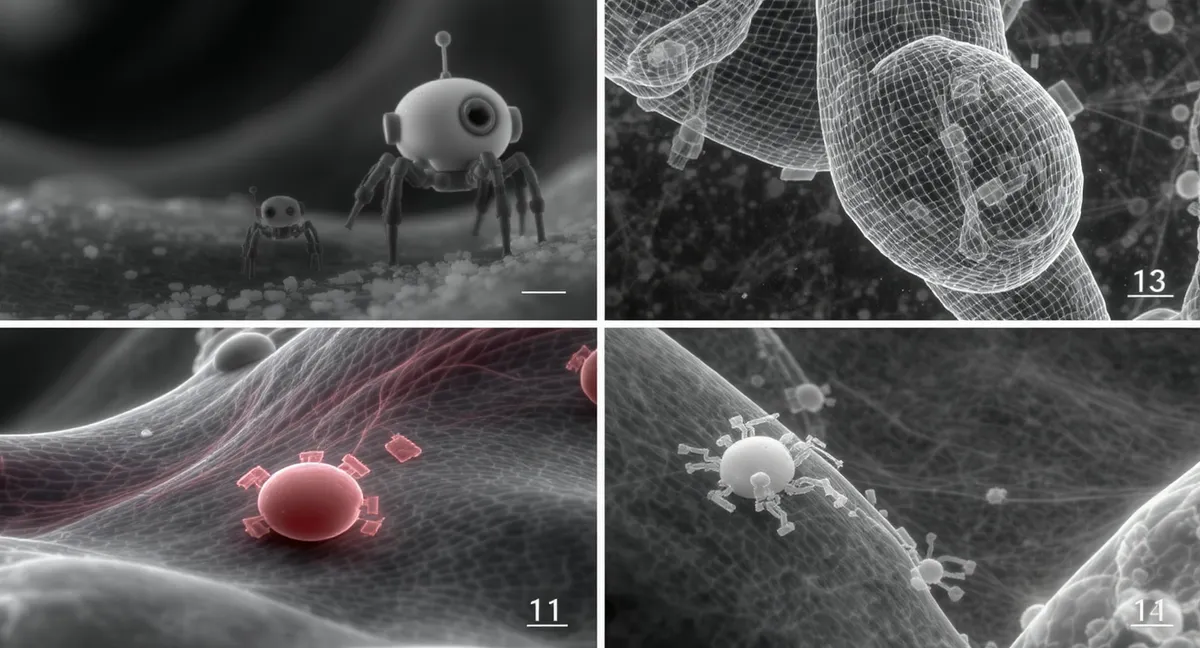
The future of medicine might be measured in micrometers. Researchers have developed robots smaller than grains of salt—tiny enough to navigate blood vessels, deliver drugs precisely where needed, and perform tasks impossible for conventional medical tools. These microscopic machines are moving from laboratory curiosity to potential clinical reality.
How Small Is Small?
A typical grain of table salt measures about 300-500 micrometers. The latest micro robots are smaller—some less than 100 micrometers across. At this scale, they’re invisible to the naked eye and small enough to travel through the smallest blood vessels in the human body.
To put this in perspective: a human red blood cell is about 7 micrometers in diameter. These robots operate in the same dimensional neighborhood, allowing them to navigate biological systems in ways larger devices never could.
How They Work
Magnetic Propulsion
Many micro robots use magnetic fields for propulsion. External magnetic systems guide the robots through the body, controlling direction and speed without onboard motors or batteries. This approach keeps the robots simple and small.
Chemical Propulsion
Some designs use chemical reactions for movement, consuming fuel in their environment to generate thrust. Others harness biological processes, essentially hitchhiking on the body’s own systems.
Shape-Shifting
Advanced micro robots can change shape in response to environmental conditions—squeezing through narrow passages or unfolding to perform specific tasks. Shape-memory materials enable complex behaviors in simple structures.
Medical Applications
Targeted Drug Delivery
The most promising application: delivering drugs exactly where needed. Instead of flooding the entire body with medication, micro robots could carry drugs directly to tumors, infection sites, or damaged tissue. This precision reduces side effects and increases effectiveness.
Clearing Blockages
Micro robots could navigate blood vessels to break up clots, clear arterial plaque, or remove obstructions in the urinary tract. They could reach areas inaccessible to conventional surgical tools.
Surgical Assistance
At the microscopic level, robots could perform surgery impossible for human hands—repairing cellular damage, connecting tiny nerves, or removing individual cancer cells while leaving healthy tissue intact.
Diagnostic Sampling
Rather than invasive biopsies, micro robots could collect tissue samples from deep within the body, traveling to specific locations and returning with material for analysis.
Current Research Milestones
University Breakthroughs
Multiple research teams have demonstrated functional micro robots in laboratory conditions. Some have successfully navigated artificial blood vessel systems; others have delivered payloads to target locations in animal models.
Material Advances
New biocompatible materials enable robots that safely dissolve after completing their tasks, eliminating the need for retrieval. Others can carry larger drug payloads relative to their size.
Control Improvements
Precision magnetic control systems now allow researchers to guide multiple robots simultaneously, enabling coordinated swarm behaviors for complex tasks.
Challenges to Overcome
Navigation
The human body is a complex environment. Navigating through flowing blood, around obstacles, and to specific cellular targets requires sophisticated control systems that are still being developed.
Power
Miniaturization limits available power. Most current designs rely on external magnetic fields rather than onboard energy storage, restricting operation to areas accessible by magnetic control.
Manufacturing
Building machines at this scale requires specialized fabrication techniques. Scaling up production while maintaining precision remains an engineering challenge.
Regulatory Approval
Medical devices face rigorous approval processes. Micro robots represent an entirely new category of intervention, requiring new frameworks for safety evaluation.
The Timeline
Current expectations place first clinical trials within the next few years, with therapeutic applications potentially available by the end of the decade. Initial uses will likely focus on well-defined problems—clearing specific types of blockages or delivering drugs to accessible tumors.
More ambitious applications—cellular-level surgery, comprehensive diagnostic exploration—will take longer, requiring advances in control, imaging, and robot capability.
Beyond Medicine
While medical applications drive most research, micro robots have potential beyond healthcare:
- Environmental monitoring: Tiny robots sampling water, soil, or air
- Manufacturing: Microscale assembly and repair
- Research: Exploring environments too small for conventional tools
The Bigger Picture
Micro robots represent a fundamental shift in how we interact with the microscale world. Just as telescopes extended human vision to distant galaxies and microscopes revealed cellular life, micro robots could extend human manipulation to dimensions previously beyond our reach.
The technology is real. The challenges are significant but surmountable. The smallest robots might make the biggest difference in medicine.
Recommended Reading
TinyML: Machine Learning on Microcontrollers
Discover how AI runs on the smallest devices. Essential reading for understanding embedded intelligence in micro-scale systems.
As an Amazon Associate, I earn from qualifying purchases.
How do you see micro robots changing healthcare? Share your thoughts in the comments below.



Comments